
The HQ of the Ministry of External Affairs, the Prime Minister's Office and the Defence Ministry designed by eminent British architect Sir Edwin Lutyens, form part of an impressive and lasting legacy left to New Delhi by Lutyens. During the 1920s and 1930s he was responsible for much of the architectural design when India was part of the British Empire.

India Gate commemorates the 70,000 Indian soldiers who lost their lives fighting for the British Army during World War l.

Rashtrapati Bhavan the residence of the President of India formally the Viceroy's House

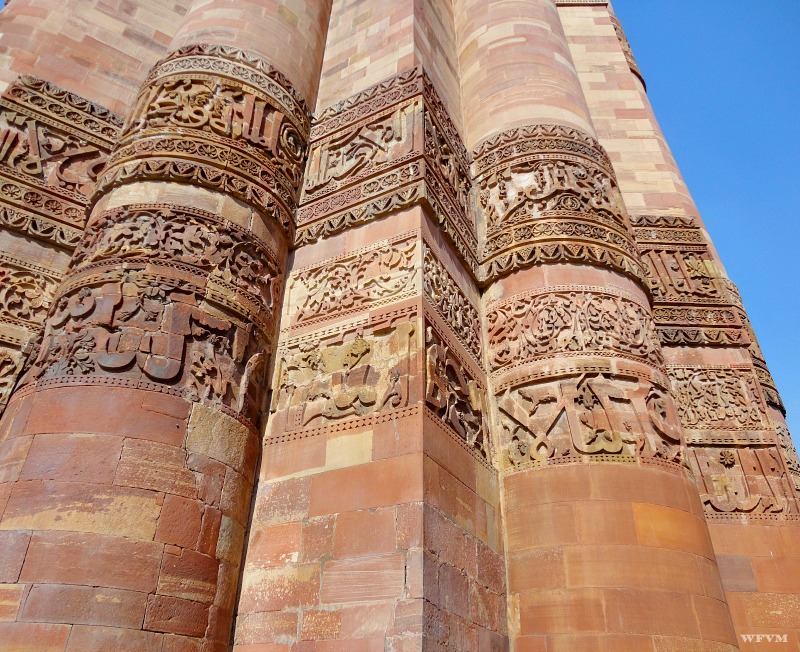 The bands of intricate carving are in the Kufic style of Islamic calligraphy
 A further tower was planned known as the Alai Minar. It was conceived to be twice as high as the Victory Tower, but the construction was abandoned. However, it is interesting to see the remains of the giant rubble masonry core that still stands today. It would have been covered with dressed stone on completion

 Carved stone cloister columns to the entrance and inside the Quwwatul-Islam Mosque which sits at the centre of the complex


Built as a Victory Tower in 1192, the Qutab Minar is the tallest minaret in the world. It was inspired by the minaret of Jam in Afghanistan, and is an important example of Afghan architecture which later evolved into Indo-Islamic Architecture. It is a listed UNESCO World Heritage Site together with the surrounding buildings and monuments.
Built in 1193 and although now lying in ruins it is still possible to appreciate and see the Mosques indigenous corbelled arches, motifs and geometric patterns amongst the Islamic architectural structures.

 |
A 23ft iron pillar, weighing 6.5 tons, and dating back to 375 stands within the ruins of the mosque. It is an enigma being made of 98 percent wrought iron which has stood for over 1,600 years without rusting or decomposing. The indentation on the pillar is the result of a cannonball fired at close range during Nadir Shah's invasion of Delhi in 1739.
Close to the Victory Tower lies the tomb of Imam Zamin - a sufi saint who came to India in 1500 from Turkestan. He lived in the complex during the reign of Sikandar Lodi. He built his own mausoleum here and died in 1539. Inside the sides are carved with perforated 'Jali' screens characteristic of the Lodi Period
It is time to head off back to the hotel, have our supper, get an early night,
and be ready to board the early morning Shatabdi Express train from Delhi to Agra where we have a date with two iconic Indian monuments
