Showing posts with label Dal Lake. Show all posts

Tuesday, 26 January 2016

Kashmiri Kahwa

Flying to Kashmir from Dehli last year we were seated next to a man from Srinagar who urged us to taste their special tea known as Kawah. A small single cup of Kawah is said to lift the spirits, create a sense of wellbeing, energise, and dispel headaches. Kahwa is an anti-oxidant - some Kashmiris consider it to have magical properties.

Our first experience of Kawah was made for us by our lovely houseboy. We imbibed the tea whilst relaxing on our houseboat's veranda, and enjoying the views across Dal Lake towards the snow capped foothills of the Himalayas. It was indeed magical, but whether it was the view or the tea I could not say.
It is possible to make yourself some Kawah, all of the ingredients are readily available. I still have a small stash of Kawah which travelled back home in my suitcase. In Kashmir they obviously use green tea and saffron grown in their mountain valleys, but whatever you have to hand will suffice.
2 teaspoons of green tea leaves
2 cardamon pods slightly crushed
1 inch piece of cinnamon bark slightly crushed,
a little honey or sugar,
two or three threads of saffron, the colour and flavour is dissolved separately in a little water by crushing gently with a teaspoon,
4/5 almonds shredded or ground (optional)  
when in season Kashmiri rose petals are used
Boil 2 cups of water add cinnamon, cardamom and tea, boil for 3 minutes and then allow to infuse over low heat,
strain, then add the saffron liguid together with the threads 
a little sugar or honey
Top with almonds, serve hot 
The result is a delicate, spicey, fragrant flavour.

Sunday, 10 May 2015

People of the Lake in Kashmir

Dal Lake, Srinagar, in the Himalayan foothills is home to people who have a unique lifestyle spent living on its waters - it is where they work, shop, raise their families, and grow flowers and vegetables on floating gardens.
Their shallow shakira boats are like a fifth limb as they skim seamlessly across the water; their children learn to paddle a boat like ours learn to walk. The lake people paddle on one side of the boat only but always travel in a straight line. If we did that we would go round and round in endless circles. Elderly men sit crossed legged on the very ends of the shakira's bow or stern and can even been seen standing up in the middle of their shallow shakira's paddling effortlessly along
How they get up from these positions without rolling themselves and the boat over is a mystery to me; their limbs and balance must be incredibly

From our veranda I counted at least 30 people clambering into this boat
I have already bought several packets of special Kashmiri tea, made with local saffron and cardamon, from this young man, but he is ever hopeful that I will buy some more.
The coat he is wearing is called a Pheran - it has a zip at the top and goes over the head like a cloak. In the winter time the men of Srinagar wear a longer loose fitting one made from kashmir (cashmere). Under the cloak they hold an earthenware container covered with wickerwork, called a Kangri, it is filled with hot embers to keep them warm during the bitterly cold snowy days. According to the owner of our houseboat  all the men wander around in the winter months looking as if they are pregnant. 
Do you know where cashmere comes from? I always assumed that it came from the wool of sheep. It actually comes from the downy undercoat of the Kashmiri mountain goat, only products from the Kashmiri goat are considered to be true cashmere.
A Kangri seller
When we first arrived at the lake the water was relatively clear, but within days, and following all the sunshine, the lake bloomed with weed. The men and women worked all day long pulling it from the water into their boats to keep the waterways clear. It was then placed in large piles, and left to rot into a rich compost to fertilise their floating gardens. The way the lake bloomed so quickly indicates, I believe, a very serious and ongoing problem for the people of the lake. 
The lake is an ornithologists delight - several types of Kingfisher, Herons, Swallows, Bitterns, Egrets, numerous water birds, and the ever present Kites patrolling the skies. The lake must look stunning in July and August when it is filled with Lotus flowers floating on top of the water.

Here the main lake is clear of weed we saw it being harvested with large water machines especially designed for the job
Our Boat-boy is resting in the back of his shakira chatting to the vegetable seller - he is waiting to see if we want to go ashore
A shopkeeper pulls alongside our shakira -
you can buy anything on the water - jewellery, Kashmir shawls, fruit, vegetables, flowers, chocolate, biscuits, nuts
That's the money changer, sim card, and camera battery seller heading off home - business is finished for today

Thursday, 7 May 2015

Am I in Paradise?

Mughal rulers thought so - they had beautiful gardens designed and laid out for them on the slopes of the Zabarwan Mountain range, part of the Himalayan Mountain chain. The British Raj thought so too when they spent their summer months here fleeing the intense heat of India's northern plains.
Time to set off in our Shakira - a shallow gondola style of boat, and make our way to the Royal Houseboat which will be our home for the next 5 nights. The boat is permanently moored to an island in the middle of Dal Lake, Srinagar, Kashmir
A ten minute journey across the lake and down a network of waterways will take us to our new abode. Our Shikara along with boat-boy will be at our disposal to ferry us around whenever needed.  He has already stashed our suitcases in the stern so lets cast-off
The Royal houseboat lives up to our expectations, it has a veranda where we can sit, talk, relax and read, or simply admire the ever changing views. That's the local Mosque across the water - those two little pink pavilions
 There are five of us staying on board along with our friendly houseboy and his assistant
Come and see inside
The veranda leads to the sitting-room and then on into the dinning-room. There is a long corridor to the lefthand side of the boat with three double bedrooms on the right
All of the bedrooms are en suite and each has a small sitting area
Life on board is very relaxed - breakfast might be a savoury omelet followed by pancakes filled with fresh banana and local honey, tsot - a kind of flat bread to eat with butter and marmalade, and a pot of Qawah - Kashmiri tea made with crushed saffron, cardamon, cinnamon, green tea and a touch of sugar 
image courtesy The Guardian
Tsot bread from the bakery on Dal Lake
Our Houseboy offers suggestions for our lunch and evening meal and we choose what we would prefer - lots of spicy vegetables, fish, chicken, lamb, or samosas filled with potato, cheese, peas, chillies, and coriander
He comes from high up in a remote Himalayan Valley, and until travelling to Srinagar could not speak any English, now he is fluent. He is very keen to improve himself, but sadly his mother died leaving him alone with his older brother and a younger sister. His father left the village to live in Delhi. He comes from the kind of isolated community you might see on a National Geographic film, completely disconnected from the rest of the world. He has very big dreams but does not know the date of his birth in order to get a passport. Birth certificates are unimportant when you live away from the 'hurly burly world' but you are stuck without one in 'real life'. To return to his village is a very difficult journey as he can only travel part of the way on public transport and then it becomes a long hard physical trek for him to finally reach his valley. We have been concerned for him and his family wondering whether or not his village was affected during the recent earthquake.
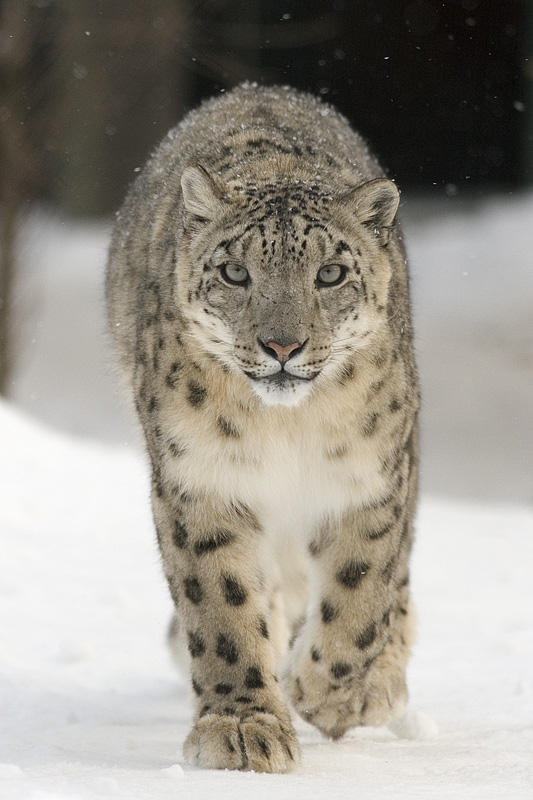
His mountain habitat is shared with the rare, shy and endangered Snow Leopard - he saw one once
A regular little visitor to the houseboat was the daughter of the boat owner.  She became very attached to me and I to her - she accompanied us on several of our visits.  She has only just turned six, but can already read, write, and speak perfect English. She is a delightful, beautiful, and highly intelligent girl whom we shall keep in touch with. On our final morning she came to bid us farewell as she started back to school following the Easter break. In a predominantly Muslim area we were surprised to learn that she goes to a Christian school started by a missionary lady called Violet Fitze in 1912. After 10 years Violet was joined by a Miss Muriel Mallinson who became the school's Principal for the following 40 years. It is said that Miss Mallinson was regularly seen riding her bicycle around Srinagar purchasing groceries at the Bazaar. She would visit her sick students or address groups of women about hygiene and cleanliness. She was always thinking of how best she could contribute to spreading education and emancipation to the girls and women of Kashmir. She introduced them to swimming, dancing and mountaineering and even took them camping and trekking - a daring and unusual feat at that time. She and Miss Fitze were great pioneers of education for girls in Kashmir - The Mallinson School is a lasting testament to them both. Today the school has exceptionally high standards being one of the most successful girls schools in Northern India. Our special little friend looked very smart wearing her brown school blazer with its school motto and badge emblazoned on her pocket. For all the world she looked as if she was setting off for the start of a new school term here in England.