Showing posts with label India. Show all posts

Tuesday, 26 January 2016

Kashmiri Kahwa

Flying to Kashmir from Dehli last year we were seated next to a man from Srinagar who urged us to taste their special tea known as Kawah. A small single cup of Kawah is said to lift the spirits, create a sense of wellbeing, energise, and dispel headaches. Kahwa is an anti-oxidant - some Kashmiris consider it to have magical properties.

Our first experience of Kawah was made for us by our lovely houseboy. We imbibed the tea whilst relaxing on our houseboat's veranda, and enjoying the views across Dal Lake towards the snow capped foothills of the Himalayas. It was indeed magical, but whether it was the view or the tea I could not say.
It is possible to make yourself some Kawah, all of the ingredients are readily available. I still have a small stash of Kawah which travelled back home in my suitcase. In Kashmir they obviously use green tea and saffron grown in their mountain valleys, but whatever you have to hand will suffice.
2 teaspoons of green tea leaves
2 cardamon pods slightly crushed
1 inch piece of cinnamon bark slightly crushed,
a little honey or sugar,
two or three threads of saffron, the colour and flavour is dissolved separately in a little water by crushing gently with a teaspoon,
4/5 almonds shredded or ground (optional)  
when in season Kashmiri rose petals are used
Boil 2 cups of water add cinnamon, cardamom and tea, boil for 3 minutes and then allow to infuse over low heat,
strain, then add the saffron liguid together with the threads 
a little sugar or honey
Top with almonds, serve hot 
The result is a delicate, spicey, fragrant flavour.

Thursday, 26 November 2015

My Masala Dabba

Twilight Taj Mahal
Tasting different spicy foods whilst travelling in Northern India and Kashmir earlier this year has encouraged me to be more experimental 
An Indian spice tin known as a Masala Dabba is a staple in most Indian homes. Cooking is so much easier when all the spices you need are close to hand rather than tucked away in the back of a cupboard, often forgotten, and turning stale.
A good Masala Dabba is made of quality stainless steel and has an inner transparent sealing lid in addition to the air tight outer lid to keep the spices fresh.

They have seven little bowls which are filled with favourite spices.
The best way to obtain spices for a Masala Dabba is to visit a an Indian shop where the spices are often cheaper and fresher than those purchased in small jars from the supermarkets. However, because I visited Istanbul's Ottoman era Spice Bazaar my Masala Dabba has been filled with spices purchased there.
Rooftops Istanbul

As I selected the spices I wanted in the bazaar, they were vacum packed for transporting home, and accompanied by a sample of turkish delight to taste - pompegranite with hazel nut, pistachio, mixed nuts, rose, orange and creme de menthe...... 
Spices to make curry apart from the Sumac - a spice used in Middle Eastern cuisine to enhance humous, meze, sprinkle on fish, chicken, raw onions, and in salad dressings. It can be used as a substute in any dish which uses lemon juice.

Saturday, 2 May 2015

Taj Mahal

Images of the Taj Mahal are familiar to us all, one of the most photographed iconic monuments in the world. However, does it live up to expectations? As far as we are concerned it far surpasses and exceeds them. It is the greatest Indo-Islamic architectural masterpiece - a precious jewel
Darwaza-i rauza - The Great Gate
We did not anticipate that the Taj Mahal complex would be so large, being bound on three sides by crenellated red arched sandstone walls. Entry is through this elaborate Great Gate. 
Immediately flanking the western side of the Taj Mahal is this red sandstone Mosque with its mirror image replicated on the eastern side. The replicated building was used as a Guest House. 
It was obligatory, according to Muslim law, for each mausoleum to have a place of worship nearby
The fourth side, behind the Taj Mahal, is open to the River Yamuna
Mumtaz Mahal
In 1631 Emperor Shah Jahan was heartbroken when his much favoured third wife , Mumtaz Mahal, a Persian princess, died giving birth to their 14th child
Emperor Shah Jahan
 The Taj Mahal is Emperor Shah Jahan's sublime expression of grief
He was reported to be inconsolable and went into secluded mourning for a year. When he appeared again, his hair had turned white, his back was bent, and his face worn
Looking back at the main entry gate from the mausoleum
The marble is covered in exquisite Calligraphy showing verses from the Qur'an, Persian poems, floral designs, plant motifs, and inlaid Pietra Dura work
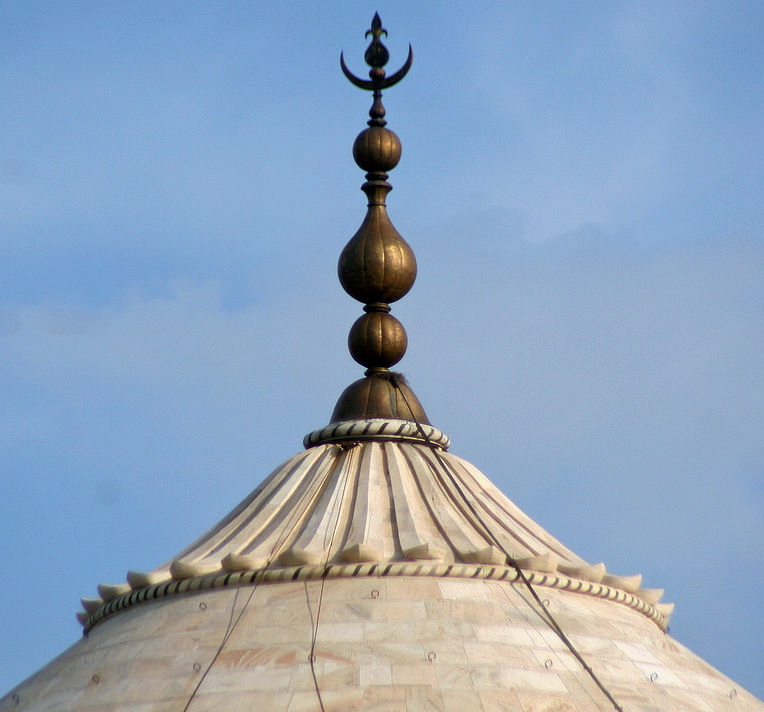
This detail was clipped from the photo above 
The white marble used in the Taj Mahal was brought from Makrana, Rajasthan, reputed to be the finest marble in the world. The marble is very dense and non porous making it resistant to water and weather. It consists of a very high amount of calcium carbonate and is an excellent building material
Evening descends, 
birds roost, the sun sets,  

and now it is time for us to fly away to Paradise!

Wednesday, 29 April 2015

Agra Fort

Agra Fort, also known as the Red Fort, was planned and built to be an impregnable military structure. It is monumental exuding a powerful presence
Amar Singh Gate
However, it has all the elegance, lavishness and majesty of an imperial palace
Lying on the right bank of the Yamuna River, it is literally three kilometres upstream from the Taj Mahal 

Emperor Shah Jahan, who commissioned the Red Fort and built the Taj Mahal was imprisoned here by his son Aurangzeb
There are so many beautiful buildings within the Agra Fort complex that it is best described as being like a small walled city.
 Deewan I am - the Hall of Public Audience
The Emperor sat just below these arches at the back of the ' Deewan I am' on his Peacock Throne holding his durbar
Emperor Shah Jahan holding a durbar in the Public Audience Hall C1650
Across the square from the Hall of Public Audience is 
the Moti Masjid - Pearl Mosque - constructed by Emperor Shah Jahan for members of his royal court. It is closed to visitors
Sitting rather incongruously in front of the Hall of Public Audience is the tomb of John Russell Colvin - British civil servant in India and part of the illustrious Anglo-Indian Colvin family. He died of cholera during the peak of the Indian Rebellion of 1857. His body could not be carried out of the Fort which after the fall of the Mughals, the British establishment in India converted into a military garrison. The tomb reminds me of the work of English architect, Augustus Pugin
A large inner marble square where the royal court lived. The golden tower to the left is where the emperor was held and died
The Emperor had three wives but there were concubines living within the complex too!
One of many open pavilions with ornate and intricate 'jali' screens 
The marble quarters where Emperor Shah Jahan was confined until his death. He was considered one of the great Mughals - his rule has been called the Golden Age
Beautiful white marble work inlaid with semi precious stones which I know as 'Pietra Dura' but is called 'Parchin Kari' in India
When looking from the open pavilions over the river it is possible to view the Taj Mahal lying romantically across the water, and
this is the view that Emperor Shah Jahan would have seen everyday - the tomb of his third and favoured wife 
The Taj Mahal is our next visit