Showing posts with label Gardens. Show all posts

Wednesday, 2 June 2021

Dunster Castle

We have visited Dunster Castle previously but never throughly explored their hillside gardens situated below and around the castle.
The gardens take you around the world through four different microclimates displaying a host of both sub-tropical and mediterranean plants.


Many exotic species grow in the grounds due to the castle's situation and mild climate. It sits on the top of a steep hill called the Tor, and has been fortified since the late Anglo-Saxon period. It has far distant views over the Bristol Channel to the Welsh coastline and enjoys the subsequent benefits of warmth from the Gulf Stream. 
These Beschorneria yuccoides - Mexican lilies, look as if they might lurch out and grab you as you pass by!!!
Each bend in the pathway reveals yet another stunning view.


Once back down we head off beneath the castles original Norman entrance and down into Dunster, a pretty village, considered to be one of the most intact medieval villages in England.

It's a great place in which to base yourself if you want to explore the counties of Somerset and Devon along with Exmoor.

The Yarn Market built in 1609 by George Luttrell of Dunster Castle was used for selling broadcloth and homespun yarns. It is now a monument to Dunster's once flourishing cloth trade.

Sunday, 5 May 2019

Two Devonshire Gardens

'Step into the spirit of the Jazz Age'
Coleton Fishacre, Devon was the country home of the D'Oyly Carte family - an Arts and Crafts house built in the mid 1920s with elegant Art Deco interiors. 
One day Rupert and Lady Dorothy D'Oyly Carte were sailing along the Devonshire coastline when they spotted a beautiful secluded valley, and decided there and then that this was where they would build themselves a country home.


A luxuriant 30 acre garden now fills the valley which runs down to the edge of the sea. The humidity in the garden is high thanks to both the sea and a stream which meanders through the valley; tender plants from the Mediterranean, South Africa and New Zealand thrive under it's canopy of exotic trees, and when visited in March, Spring was already well advanced compared to the rest of the country.  
The architect for the house and the terraced areas was Oswald Milne, a student of Sir Edwin Lutyens.

"The loveliest place in the world"
Just a few miles away from the D'Oyly Carte country home is 'Greenway', the much beloved holiday home of the writer, Agatha Christie.
"One day we saw that a house was up for sale that I had known when I was young....So we went over to see Greenway, how beautiful the house and grounds were. A white Georgian house of about 1780 or 90, with woods sweeping down to the River Dart below, and a lot of fine shrubs and trees - the ideal house, a dream house".
This is just a glimpse at the holiday home where the famous author, her family, and many invited guests would spend their summers and Christmases. 
Guests could explore the many secret pathways within the extensive grounds, wander down to the Boathouse at the edge of the Dart and go sailing. Lawn croquet and clock golf were also popular pastimes. 
via National Trust
In the evenings guests were often to be found sitting around together, whilst Agatha held them enthralled, as she read to them the latest chapter from her current mystery novel.   

Thursday, 16 August 2018

Blenheim Palace

John Churchill, the 1st Duke of Marlborough, defeated the French at the Battle of Blenheim in 1704. The English name 'Blenheim' is a derivative of Blindheim, a small Bavarian village that lies on the left bank of the River Danube. The Franco/Bavarian army and the English army met on the banks of the Danube, and the ensuing battle took place in and around the village. 


To show her gratitude, Queen Anne gave him the ruined Royal Manor of Woodstock, Oxfordshire, along with £240,000 with which to build a house to commemorate his achievements. 


Sir John Vanbrugh, aided by Nicholas Hawksmoor, 
 designed and built Blenheim Palace between 1705 and 1722. It represented the beginning of a new but short lived style of architecture, known as English Baroque. 
The Grand Bridge 
The landscaped park designed and created by Lancelot 'Capability' Brown was considered to be 'a naturalistic Versailles'. Vanbrugh's elegant bridge spans the Great Lake and Queens Pool, and enhances Brown's surrounding landscape with a scenic driveway.


Heading inside beneath the grand entrance portico, I suddenly spotted these eyes looking down.
Painted by British artist Colin Gill in 1928 they depict the bright blue eyes of Gladys Duchess of Marlborough. Gladys was renown for her good looks and exceptional blue eyes. The brown eyes are those of her husband, the 9th Duke.


The Great Hall
The hall, which stands a remarkable 67 feet high, is made out of locally quarried Oxfordshire limestone with exquisite carvings done by Grinling Gibbons and his assistants

The ceiling was painted by Sir James Thornhill in 1716 and shows the 1st duke offering his battle plan to Britannia, surrounded by allegorical figures. 


A series of nine large silk tapestries in three connecting State Rooms depicts all the victorious campaigns of the 1st Duke of Marlborough - this last tapestry shows the final French surrender to the duke (seated on the white horse) at Bouchain in France. Sir Winston Churchill, who was born at Blenheim Palace, said that the 1st Duke's battle manoeuvres shown within these nine tapestries reveal his military genius, and said that the Battle of Blenheim completely changed the 'political axis' in Europe at that time.

A marble statue of Queen Anne dominates the end of the library.


To the rear of the house is a water garden laid out in the 1920s by French architect Achille Duchêne in a c17th Italianate style with detailed parterres and fountains. 

Steps lead down from the water garden to the water terrace where various paths then meander off through Brown's landscape and around the side of his great lake.


This obelisk fountain was carved in Gian Lorenzo Bernini's studio and was gifted to the 1st Duke in 1710 by the Spanish Ambassador to the Papal Court in Rome. It is a one-third scale marble copy of Bernini's Fountain in the Piazza Navona, Rome. It depicts the four great rivers of the world at that time - the Nile, the Plata, the Ganges, and the Danube, each one being represented by a symbolic figure sitting on rocks beneath the obelisk.

The obelisk at the other end of the water terrace was created to bring symmetry to the one created by Bernini.


This wall of caryatids linking the terraces was carved on site by French sculptor Jules Visseaux. The head and torso of the male caryatids was modelled on one of the palace's gardeners, who happened to walk by one day as Visseaux was working. 


Walking around the lake reveals just how green our landscape was during last May. 


Our final destination was a lovely walk through Brown's landscape and along the side of his lake to the Cascade. It was originally built as the overflow when Brown dammed the valley to create the Great Lake, and Queens Pool.

Blenheim became a World Heritage Site in 1987, in recognition of the quality of the architecture by Vanbrugh and Hawksmoor and Brown's landscaping. The house and the 2,000 acres of parkland and gardens are all Grade l listed.

Wednesday, 27 June 2018

For Catherine

As we travelled along narrow blossom filled country lanes, through quaint Cotswold villages, passed fields carpeted in the hues of blue and yellow from the Linseed and Rapeseed (Canola) crops, suddenly we spotted a sign.

It pointed to Winchcombe Pottery, a place that I wanted to visit, as sometime ago I had mentioned to my blog friend Catherine that I would. Catherine lives in the United States, and although she has never visited the pottery, she is in fact familiar with it, and wrote about it on her own blog. 
Hope that you enjoy Catherine💛
There was a pottery on this site from 1800 which then produced a range of farmhouse wares for the surrounding area, but after the end of WWl it fell into decline. 
In 1926 Michael Cardew, who trained under the distinquished British potter, Bernard Leach, rented the pottery buildings and set about restarting it up again.

It is one of the longest running craft potteries in the country, and makes some of the finest and most practical domestic pottery wares. The pottery still follows the 'Arts and Crafts' ideal of being both beautiful and useful.

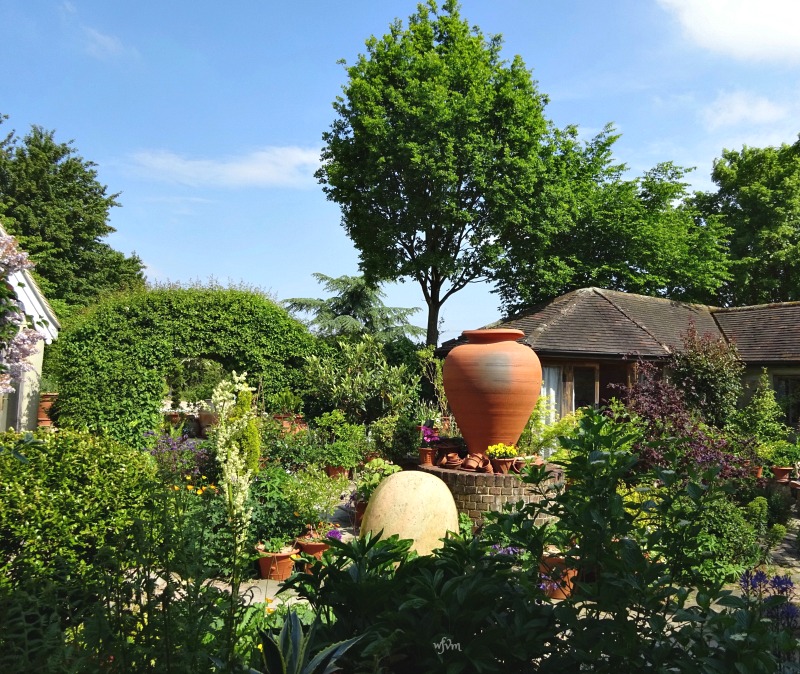
Their terracotta pots grace many homes and gardens throughout these isles from modest cottages to grand stately homes.
It was coffee time when we arrived, and all of the potters had left their wheels and were sitting around in the garden having a drink and chatting. It is a very relaxed, friendly place for a visit - entrance is free, you can wander around the workshops and see the potters at work. 

There is a shop selling their pots along with jewellery, glassware, and paintings made by other local craftspeople, together with a cafe where you can buy homemade refreshments.


********
Update
My computer is working very well with thanks to my eldest son, and my granddaughter's boyfriend, but my blogger problems continue when creating new posts. There was nothing basically wrong with the computer, it was all down to my blog. However, I have discovered that I can only write new posts as long as I sign out of blogger and then sign back in again. It is a nuisance, but it is the only way that I have found which enables me to continue with the blog. 
I returned home late last night after a long journey - my head is full of the many exciting things seen, but, I am unable to process them, as my mind has not yet caught up with my body. 
The national flower of the country visited.