Showing posts with label South Africa. Show all posts

Saturday, 14 October 2017

Nelson Mandela

Whilst I am away from the computer here are
five quotes from Nelson Mandela

"Education is the most powerful weapon that you can use to change the world"

"I learned that courage was not the absence of fear, but the triumph over it. The brave man is not he who does not feel afraid, but he who conquers that fear"

"It always seems impossible until it's done"

"Do not judge me by my successes, judge me by how many times I fell down and got back up again"

and finally

"No one is born hating another person because of the colour of his skin, or his background, or his religion. People learn to hate, and if they can learn to hate, they can be taught to love, for love comes more naturally to the human heart than its opposite" 
 This huge bronze statue of a young Nelson Mandela stands in the gardens of the Union Building, Pretoria - seat of government, and the building where he was sworn into office in 1994 - the first black president. The statue was dedicated one day after the former president was buried in his ancestral village of Qunu, following 10 days of mourning.

Wednesday, 11 October 2017

On Safari in Kruger National Park

where shrubs have thorns resembling daggers, teeth are pointed and sharp, and claws can rip flesh wide open.


What a scary place for this petite adult Sharpe's Grysbok! - agile but very timid - his defence is to retreat into an aardvark burrow or similar when threatened. 
A Lion lying hidden in the undergrowth with his Lioness

However, little does he know that this younger, powerful, male has also appeared on the scene, and just a few metres away
  He looks around, takes in the scene, then lies down, and is completely hidden


Southern Ground Hornbills are typically seen marching along in small family parties probing the ground for insects. They are on the endangered list, but despite their terrestrial habits, are strong fliers.

This was a close encounter - an elephant charging towards me - a great photo opportunity whilst sitting in our open top jeep, fortunately our ever alert competent ranger moved off quickly.
On a far distant escarpment we spotted a solitary White Rhinoceros complete with his precious horn. South Africa is at the forefront of rhino conservation; some 75% of the world's surviving rhinos live within its borders. It is a continual battle protecting them from the poachers and the rangers latest weaponry is making use of drones.
 A keen eyed Vulture can soar on thermals for hours on end with a vision that is practically unmatched in the annimal kingdom

Yellow-billed Hornbill - nests in holes in the trees. During incubation the female plasters up the entrance to seal herself in; the male feeds her through a slit until the eggs are hatched. 
 During a break for lunch these keen eyed Cape Glossy Starlings were after our food.
We needed this lunchtime to relax a little as we had been up and on the go before daybreak.


The area is suffering a severe drought and is desperate for the rains to arrive. However, these Zebras, for example, don't look under nourished so there must still be plenty of nourishment in the vegetation even though it appears to be dry and parched.


Mum with her two young warthogs - in family groups they are a regular sight trotting briskly across the savannah with their long, thin tails held aloft.


Giraffes are the world's heaviest ruminants and the tallest land mammals which feed from the canopy. They can be found in groups of around 15 and a herd may be all male, all female, or mixed. This male appeared to be travelling alone, but suddenly we spotted a much smaller female following in his wake.


Kori Bustard - loosely related to cranes but more sturdily built. It is the world's heaviest flying bird, weighing up to 28lbs.
The African Buffalo is a powerful animal - they like to wallow in muddy water even more so than elephants or rhinos, and seldom stray more than a few miles from a reliable water source.  The birds that can just be made out on the tree behind the buffaloes are oxpeckers. They feed exclusively on the backs of large mammals eating the ticks and parasites. Sometimes large prides of lions attempt to prey on buffaloes but with very mixed success.

Saw several species of antelope, much revered by the San, the hunter gatherers who once inhabited South Africa - the antelope is the animal most commonly depicted on their ancient rock paintings.
Growing in Kruger Park I saw this wonderous

  Kigelia africana - sausage tree with its voluptuous red velvet flowers but also sausage like gourds up to a metre long.  As daylight falls it becomes a hive of activity when bats and night insects arrive to drink nectar from the flowers.
The sausage tree has been used by indigenous people and traditional African healers for hundreds of years to treat all manner of skin complaints from ulcers and sores to serious conditions such as leprosy and skin cancer. As well as anecdotal evidence from traditional use, there now exists a significant body of scientific research supporting its efficacy. 

Monday, 9 October 2017

Blyde River Canyon

 Even though our flight from Cape Town to Johannesburg lasted for 2½ hours our road travels were again suddenly accompanied by the Drakensberg Mountain range. This huge escarpment stretches for 700 miles eventually forming a natural border with Lesotho.
We had no idea what we were about to see as we walked across the top of this escarpment on our journey travelling to the dry bushveld plains of Sub-Saharan Africa.

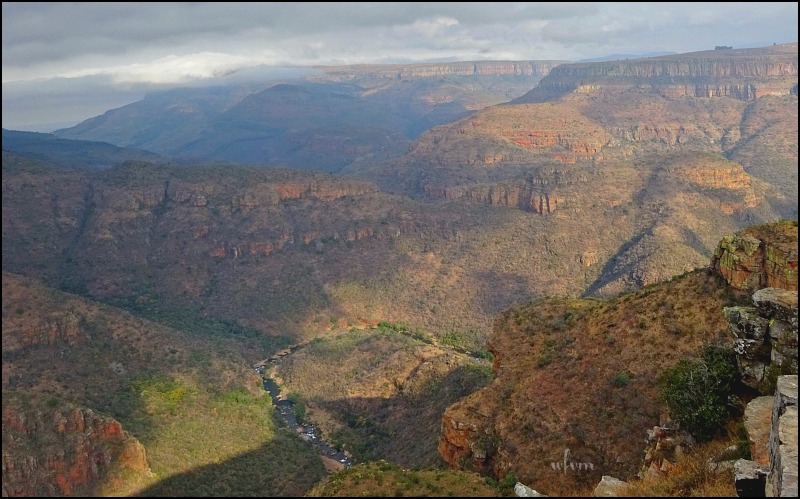
The panoramic route we travelled passed by the fissured ridges of the Drakensberg Mountains - the most spectacular section of the Canyon. 
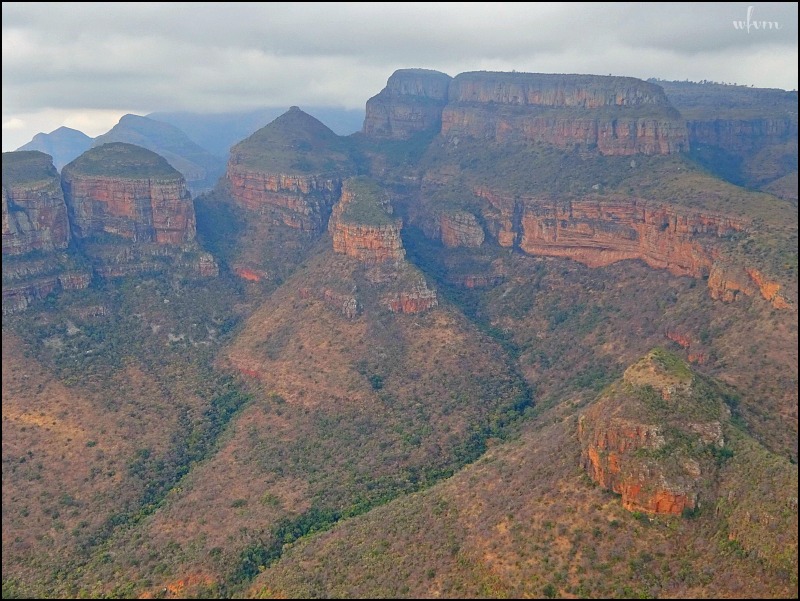
 The fast flowing Blyde River, has over the centuries, carved its way though 700m of shale and quartzite to create a scenic jumble of cliffs, islands, plateaus and bush-covered slopes that form a 20 km canyon. To give some scale to the canyon the turquoise dot just visible in the river on the left is a pleasure cruiser boat, and notably the river is home to crocodiles and hippopotamus.
The Three Rondavels
Rondavels are traditional cylindrical Zulu huts with conical thatched roofs - these rock formations were shaped by the erosion of soft rock beneath a harder rock cap that eroded more slowly. 
The final leg of our journey is now less than two hours away. 

Thursday, 5 October 2017

Dutch Settlers and their Architecture in South Africa

Dutch settlers were the first of the European trading powers to set up permanent settlements in South Africa. In 1652 the powerful Dutch East India Company built a fort and established a supply station under the command of Jan Van Riebeeck on a site that later became Cape Town.
The Stellenbosch wine area is situated in the fertile valleys lying below the Drakensberg mountain range. This Western Cape area is just 31 miles from Cape Town, it is where many Dutch Settlers moved, cleared the land, and established farms. Vineyards began being planted when French Huguenots fleeing persecution in France during 1687 to parts of Europe were invited to South Africa by Dutch Settlers in 1688. They brought with them the skills of wine making from France which they shared with their Dutch hosts. 
An avenue of Eucalyptus saligna at a vineyard visited 
The arrival of Huguenots in Britain is of personal interest to me because it is understood in our family that my maternal grandmother was descended from them - her surname was Jacques. 
For much of the 20th century the South African wine industry received minimal international attention. Its isolation was exacerbated by the boycotts of South African products in protest against the country's system of Apartheid. It was not until the late 1980s and 1990s when Apartheid was ended, and the world's export market opened up, that South African wines began to experience a renaissance. 
It is in the heart of these winelands that the development of Cape Dutch architecture can be seen
The 'Wolf's nose' gables were the first front gables to be designed. They were built as a functional 'eyebrow' over a dormer window providing light for the loft above the front door. From this humble gable, based on the medieval architecture of the Netherlands, the style of Cape Dutch gables grew into one of the most recognisable 'settler' architectures in the world. 
By the mid-1750s, the gables at the Cape had reached their full height, a reflection of the prosperity at the time. From then on, gables would be defined by whether the edge was concave or convex in shape.
The Holbol Gable was a natural progression from the earlier bolbol gable as the fashion of the day moved towards the baroque. Its defining feature was a mix of convex and concave edges. 
The Neoclassical Gable was the last of the Cape Dutch gable styles before the Second British Occupation of the Cape in 1806. The style could be defined as singularly elegant, restrained and dignified. The pediment could be triangular, rounded or even sculpted.

Friday, 29 September 2017

Cape Town

We landed in Cape Town at lunch time and two hours later found ourselves travelling to the top of Table Mountain in a cable car, and we hadn't even upacked.
Table Mountain is mercurial - even if the skies are blue the summit can still have a white layer of cloud lying across the top like a fluffy duvet - it was totally clear, so we made the most of the opportunity, and up we went.
 Table Mountain is 1067 metres high, and I was surprised at just how exotic the area was as we stepped from the cable car.
I was excited to see these exquisite tiny Orange Breasted Sunbirds feeding on nectar from the Aloe flowers. They were totally unconcerned that I was within touching distance - for me it was magical just watching them and seeing how their iridescent feathers glistened in the sunlight.


We took a stroll around this colourful Malay area of Cape Town before unpacking at the hotel and going for an evening meal down on the lively waterfront. Malay slaves were brought to the Cape Colony from Java in the late 1600s and carried with them an intimate knowledge of spices that was to have a profound influence on Cape cooking.
❖❖❖❖❖❖
We were, however, shocked at the shantytowns that we had seen on our way into the city near the airport, and the way in which so many black people still live today. Gradually some of the shantytowns are giving way to new townships built with what are known as 'Mandela' houses. 'Mandela' houses are made from brick, a big improvement from the chaotic corrugated iron shacks and wooden huts, but still very basic. They have only one small living room and two bedrooms in which eight people or more may reside. I did not take any photos of the shantytowns as I thought it too intrusive, but I will never forget what I saw.

We gazed out to sea through these giant sculptured glasses and could just make out Robben Island lying on the horizon - the spot where Nelson Mandela served 18 of his 27 years in prison.


The ocean that pounds the coast around Cape Town is our own familiar Atlantic, but very soon it will be meeting and mingling with the Indian Ocean, and that is where part of our journey eventually takes us.