
The sap is rising, days grow longer, bulbs busily thrust themselves through the earth, some even have flowers. Trees stand unadorned, silhouetted in their skeletal nakedness against Winter's skies. They too await Spring's arrival, their bare limbs show signs of buds but throughout the year many play host to some of Mother Nature's frilly, lacy, little jewels.
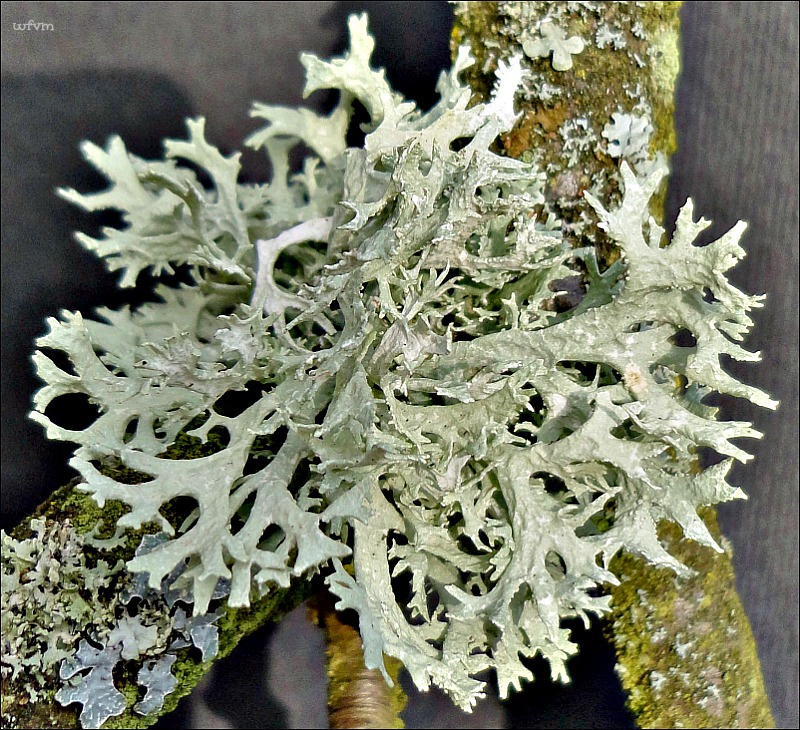
Lichens are a partnership between members of two different kingdoms that live
together in a special, mutually beneficial relationship - a symbiosis

Each lichen is made up of a fungus and an algae: the body of the lichen is built up by a tough fungal hyphae, and the algae lives inside that framework

The fungus protects the algae from the harsh world outside, and provides it with water and mineral nutrients. The algae makes its own food by photosynthesis, then leaks some of this food, which in turn is absorbed by the fungus as it cannot make it's own food
 Their
partnership is so tough and self-reliant that lichens can grow on rocks in the desert where nothing else survives. When
it is too dry, too hot, or too cold, lichens go into a state of
suspended animation until conditions improve. Because the algae make up
only 5% of each lichen, and are out of action for much of the time, lichens grow very slowly - only a few millimetres per
year. They make up for this by living for centuries, or in some cases,
millennia
Their
partnership is so tough and self-reliant that lichens can grow on rocks in the desert where nothing else survives. When
it is too dry, too hot, or too cold, lichens go into a state of
suspended animation until conditions improve. Because the algae make up
only 5% of each lichen, and are out of action for much of the time, lichens grow very slowly - only a few millimetres per
year. They make up for this by living for centuries, or in some cases,
millennia

Lichens
have one serious weakness - they must absorb their mineral
nutrients from the rain. So if the air is polluted with sulphur dioxide,
this dissolves in the rain and is absorbed by the lichens which often
die as a result - lichens are a predictor of good air quality.
All of these lichen photos were taken in our garden - the row of skyline trees was taken on Exmoor
The fungus protects the algae from the harsh world outside, and provides it with water and mineral nutrients. The algae makes its own food by photosynthesis, then leaks some of this food, which in turn is absorbed by the fungus as it cannot make it's own food
All of these lichen photos were taken in our garden - the row of skyline trees was taken on Exmoor
