
Hidden down narrow leafy country lanes, the Old Manor, Norbury and the church of St. Mary and St. Barlok are worth the hunt - the seeker is well rewarded by the treasurers that they find.

The Old Manor, the former seat of the Fitzherbert family, is a rare example of a medieval hall house built c.1290.

The Fitzherbert family built a Tudor house adjoining
The Old Manor in the mid-15th century, rebuilt in c.1680 but still retaining many of its original features.

The present church has undergone various stages of development. The first church being Anglo-Saxon and the second a Late Norman Church built by the Fitzherbert family in c.1179, later alterations and additions were made during the 14th and 15th C. The church has some splendid medieval features, one of its crowning glories being eight very rare grisaille stained glass windows dated c.1306.


.svg.png)
The ancient arms of France shown in one of the windows reveals the limitations of the glazing techniques used during that early period


Window showing three lions passant England - King Edward l (1272 - 1307)
 Great East Window




This splendid window has been described as a 'Lantern in Stone' with the light pouring through it. Sadly, although old, much of the glass is not original. Throughout its history a variety of restoration work has been attempted from, at times, indifferent restorers, as can be seen in the bottom lefthand corner.
The shafts of Saxon crosses discovered during restoration work dating from c.900
Effigy of Sir Henry Fitzherbert - it is often mistakenly assumed that an effigy with crossed legs indicates a Knight Templar who fought in the crusades. However, nearly all stone carvings during the mid 13th century have crossed legs - it was simply the style at that time
In the Chancel lie the Alabaster Fitzherbert tombs which are considered to be amongst some of the finest in the country. They are carved in Chellaston alabaster from the Nottingham School (probably Tutbury) and were originally richly gilded and coloured. The details are wonderfully and faithfully carved with great care and are thought to have been done in c.1491.

Nicholas Fitzherbert, llth Lord of Norbury died in 1473 having 10 sons and 7 daughters by his two wives. He is shown in full plate armour. The children and his two wives are shown as 'weepers' on the sides and end of his tomb
 |
On the north side of the chancel lie the effigies of Ralph Fitzherbert, 12th Lord, son and heir of Nicholas beside his wife, Elizabeth. On the sides are shown their children as 'weepers'. Two vandalised angels
support Elizabeth's cushion, Ralph's head rests on his helmet.
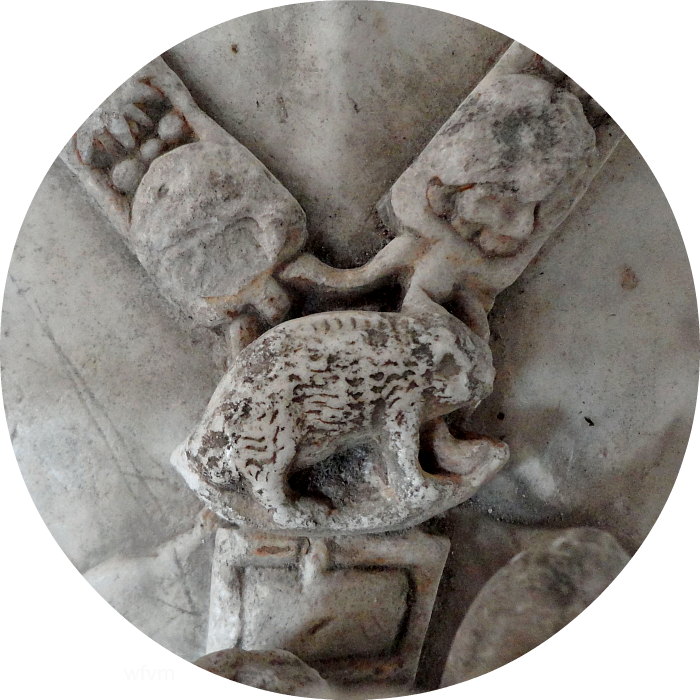
Hanging around Ralph's neck, can be seen a Yorkist livery collar of alternating suns and roses, which importantly shows the White Boar livery badge of the English King Richard lll as a pendant. The badge was an important symbol of political affiliation in the Wars of the Roses'.
This copper-alloy boar was found in October 2012 on the Thames foreshore near the Tower of London. Experts believe it may have decorated an item of leather once owned by a supporter of Richard lll, or possibly even the king himself.
Sitting on top of the lion at Ralph's feet is a Bedesman praying on his rosary for the souls of the departed
Whilst on the subject of tombs I must show you one of the strangest tombs I am aware of which we discovered after a short journey from Norbury to a church in Fenny Bentley.
Here in the church of St Edmund, King & Martyr, lies Thomas Beresford and his wife Agnes
Thomas Beresford fought at the battle of Agincourt under Henry V in 1418. He settled at Fenny Bentley and married a wealthy heiress Agnes Hassall who between them raised a family of 21 children. Thomas and his wife Agnes together with their 16 sons and five daughters are all shown in shrouds or as we would call them today 'body-bags'.
Why are they shown in shrouds?
The tomb is said to have been made 100 years after their deaths
Some believe the sculptor lacked the necessary skills to carve their effigies or that he did not know what they look liked, but
the Beresfords were a wealthy family and there would have been paintings showing their likeness.
There are more question marks surrounding this village tomb than there are answers
*****
Leaving Derbyshire behind, we crossed over the county of Staffordshire and headed into Shropshire for a few days.

.svg)