
Viroconium in Shropshire, now Wroxeter, was the fourth largest city in Roman Britain. It began as a legionary fortress and later developed into a thriving civilian city. Though much still remains below ground the most impressive visible feature is the huge wall that divided the municipal baths from the exercise hall (Basilica) in the heart of the city.


The Basilica - an artists impression of how the exercise hall would have looked

It is likely that the inhabitants of Wroxeter were able to maintain an urban way of life long after the Romans' formally abandoned control of Britain in the early fifth century. However, by the mid-seventh century everybody had left, perhaps moving to small communities developing nearby. Gradually the deserted buildings of Wroxeter were mostly dismantled and reused. Roman stone can be seen in nearby churches and houses.

This country road running between the ruins was the principal city street separating the Basilica from the Forum. Today this road is part of Watling Street, which runs all of the way from what was Viroconium (Wroxeter) to Londinium (London) onwards to Portus Dubris (Dover) - the sea crossing point back to Rome.

These are the only visible remains of the Forums once impressive colonnade to the right of which there was a large market square and town hall
 |
| Remains of the hypocaust - underfloor heating system |
Heading across Watling Street to the area where the Forum stood is a Roman Town House constructed about 4 years ago. Built using only materials that would have been available locally to the Romans and without the aid of any modern day machinery, the builders were aided in their quest by a manual on Roman building written by engineer Vitruvius 2,000 years ago. The building process helped shed new light on how the incredible feats of ancient engineering were achieved. This replica house stands as testament to the energy and ingenuity that defined so much of the Roman era.

The house was inspired by buildings excavated at Wroxeter. It stands on a platform to protect the important archaeological remains of the Forum which lie beneath it. The house reveals just how comfortable life could be in Roman Britain around 320 AD.


I think that this symbol on the outside wall of the house represents Sol Invictus "unconquered Sun" the official sun god of the later Roman Empire and a patron of soldiers. It seems to fit in with the fact that Viroconium was originally a legionary fortress. I would be happy to learn any other thoughts that you might have as this is pure guess work on my part.


House owners often rented out parts of their property to tenants, who used the space to sell goods. Shops occupied the front portion of many houses that faced out onto the street. They sold pottery, vegetables, furs - even fast food such as ready cooked meats.

The Triclinium where guests were entertained

The painted walls are decidedly amateurish

in contrast to the luxurious Roman villa at Boscoreale near Pompeii, which has beautifully detailed wall paintings designed to make the room appear more open and spacious.


Having bathed in the frigidarium (cold room) the Romans would then move on to the tepidarium (warm room) and finally the caldarium (hot room)
All of the terracotta tiles used in the project were handmade using moulds and the slate tiles split and shaped using Roman tools.
Our hotel was literally 2 mins walk away and stood on ground that was once Viroconium. Alongside the hotel was the Church of St. Andrew, Wroxeter
but what do we see here?
....entrance gates and wall using Roman columns and Roman stone
and the principal church walls and tower were built with substantial amounts of Roman stone
the enormous font is the base of a Roman column
A Morris & Co (1902) window depicting St. Andrew and St. George
Having just visited Derbyshire and shown a post with very fine Chellaston alabaster tombs, I was very excited to discover this equally outstanding alabaster tomb thought to have been made by Richard Parker of Burton-on-Trent, and still retaining most of its original colouring!
Sir Thomas Bromley (d.1555) and his wife Mabel Lyster - Sir Thomas was Chief Justice of the Queen's Bench.
On the left the Arms of Thomas Bromley and
on the right his Arms impaled with those of his wife
In the centre their daughter, Margaret
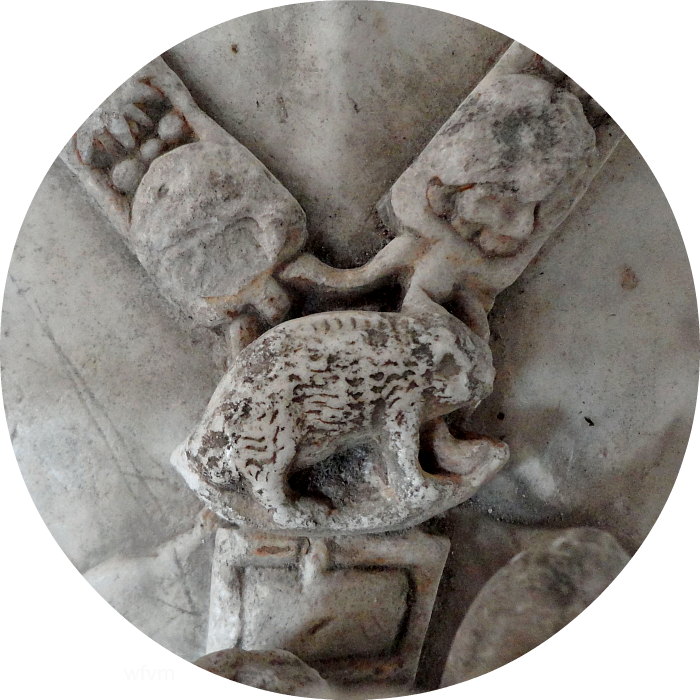
dressed in his judicial robes
On the south side of the chancel lies their daughter Margaret. The tomb is not quite such fine quality but is still made in alabaster and thought to have been done by the Royley workshop, Burton-on-Trent
Margaret died 1578 and lies with her husband Sir Richard Newport who died 1570
Their eight children are depicted as 'weepers' around the tomb - here you can see four daughters and two sons. Three daughters appear to have married as their arms have all been impaled onto those of their husband but the daughter on the right must have been unmarried as she carries arms the same as her brothers
Completing the eight children - the end of the tomb shows a son and a baby girl who most likely died shortly after birth as she is depicted in swaddling clothes
St. Andrew's is a large church and the parish was unable to maintain it. Consequently it closed in 1980, being placed in the care of The Churches Conservation Trust in 1987 following repairs by English Heritage and excavations by Birmingham University Field Archaeology Unit


.svg.png)




.svg)