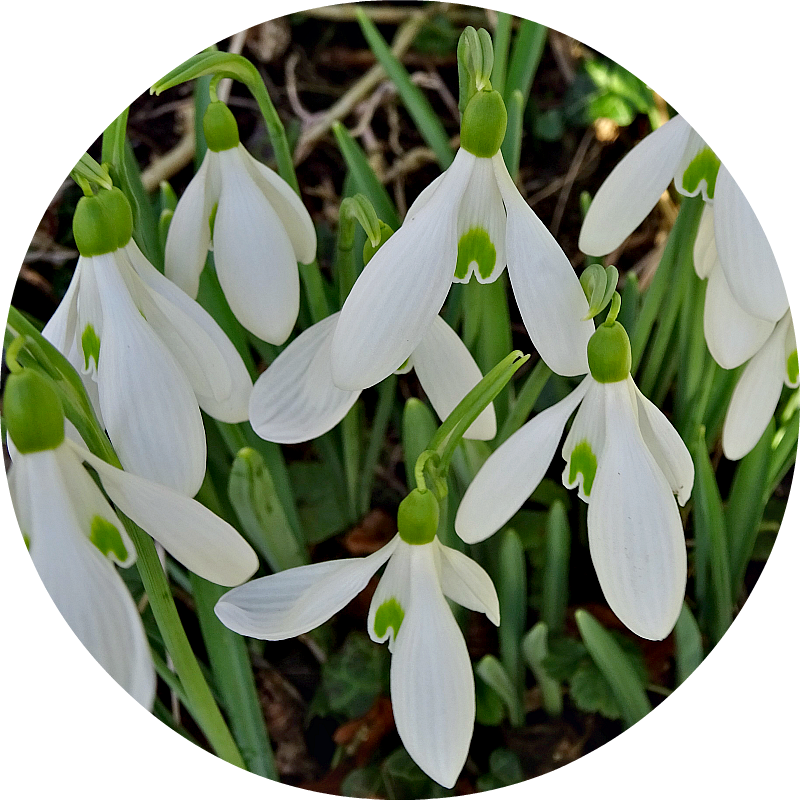

snowdrops en masse

Rococo was an artistic movement and style developed in the early C18th in Paris. It not only involved the arts and architecture but also gardens. Today's Rococo gardens are mainly to be found in France and Italy - they were exhuberantly created using extravagant pavillions, fountains and stairways. However, the Rococo garden movement also had a fleeting craze here in England, and although not as grand as their European cousins, they sparkled with unrestrained delights which showed off their ostentatious owners often new found wealth. The Rococo Garden in Painswick is a very rare suvivor in England, and at this time of year hosts a special harbinger of Spring - the snowdrop. The garden grows thousands of them including various different cultivars but the principle snowdrop grown is Galanthus atkinsonii which is commonly known as the "big one". As a result of the mild winter weather the snowdrops have peaked three weeks early.

This elegant white stucture is called the Exedra, in architectural terms an exedra is a semicircular recess or plinth often crowned by a semi-dome. Used as a folly here in the Rococo garden it makes a striking focal accent which can be seen from many different points in the garden


The Anniversary Maze spells '250 years' and was newly planted at the beginning of the millenium

Snowdrops have been growing in this Grove for over 250 years. In the C18th the owners of the house traditionally opened their garden to all the local Painswick residents for one Sunday each snowdrop season and invited them to pick themselves a posy of six snowdrops each

A Palladian seating folly which has been given some exhuberant rococo emblishments
 The Kitchen Garden prepared and ready for planting - it looks spectacular during the apple blossom season when the cordoned fruit trees flower

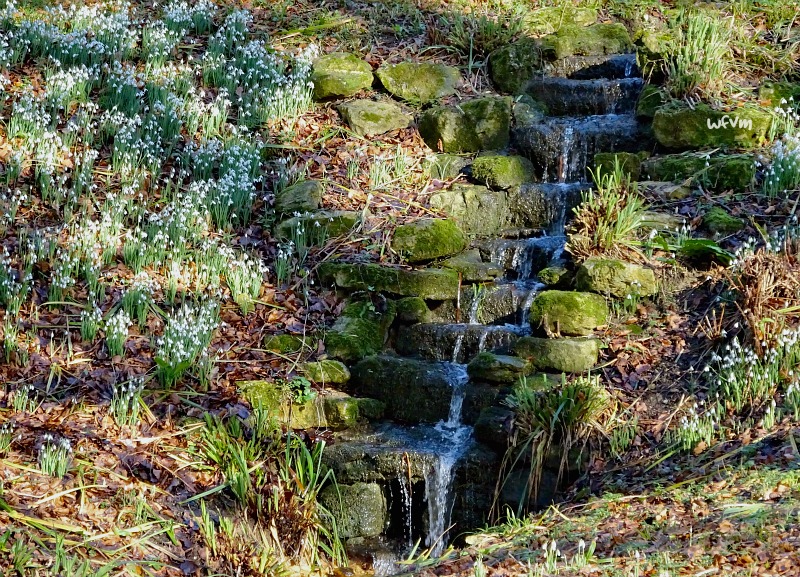
A Plunge Pool accompanied by running spring-water were essential elements in an C18th century garden. Throughout that period there was an interest in following a cold regime, which was claimed to extend life expectancy. This included spending time out of doors, taking plenty of outdoor exercise and bathing in cold water.
The philosopher John Locke wrote in 1703....
"Everyone is now full of the miracles done by cold baths on decayed and weak constitutions, for the recovery of health and strength;"


Arched walkway
 View across the fish pond to the Red House
 The Red House sits at the head
of the valley having commanding views of the garden. It is both flambouyant and eccentric, displaying one of
the main features of the Rococo period of asymmetry. The doors to the
Red House are locked in the open position as it plays host to a colony of Lesser Horsehoe Bats roosting in the roof - an extremely rare bat in England and only found here the southwest of the country
The Red House sits at the head
of the valley having commanding views of the garden. It is both flambouyant and eccentric, displaying one of
the main features of the Rococo period of asymmetry. The doors to the
Red House are locked in the open position as it plays host to a colony of Lesser Horsehoe Bats roosting in the roof - an extremely rare bat in England and only found here the southwest of the country

 The Red House was put on the English Heritage 'at risk' register in 2007 when it was discovered that there was evidence of structural movement. In the winter of 2009/10 underpinning was carried out, and at the same time the windows were replaced. They are inscribed in Latin with the Songs from Solomon.
 As it's name suggests The Eagle House sits at the highest point in the garden and has far reaching views across the garden to the countryside beyond


 It seems appropriate to conclude the post with a snowdrop

A Palladian seating folly which has been given some exhuberant rococo emblishments
A Plunge Pool accompanied by running spring-water were essential elements in an C18th century garden. Throughout that period there was an interest in following a cold regime, which was claimed to extend life expectancy. This included spending time out of doors, taking plenty of outdoor exercise and bathing in cold water.
The philosopher John Locke wrote in 1703....
"Everyone is now full of the miracles done by cold baths on decayed and weak constitutions, for the recovery of health and strength;"
In the C18th Plunge Pool activities at Painswick were presided over by Jan Van Nost's statue of Pan which has now been repositioned to another more protected location within the garden
Arched walkway
This fanciful creation sits on the unaffected stump of a Beech Tree which had become diseased. It will quickly mellow and blend in with the other trees in the glen. The work was completed by a local chainsaw sculptor, Denius Parson literally days ago - it was inspired by Schloss Neuschwanstein in Bavaria