Berneray Island, reached via a recently built causeway from North Uist, has onward ferry travel to the Island of Harris and Lewis

 |
| via |
Exquisite golden beaches and azure waters, are to be found at the southern end of Harris. Hardly a soul to be seen - it is pure magic

St. Clement's church on Harris was built by the MacLeod Clan Chiefs of Dunvegan and Harris as their burial place in 1520 but the church fell into ruins following the Protestant Reformation in 1560. It was rebuilt two hundred years later by Captain Alexander MacLeod, but sadly within three years it was badly damaged by fire. In 1873 the building was restored once more by the Countess of Dunmore. Inside is found one of the finest C16 tombs in Scotland - Alasdair Crotach MacLeod's Tomb.

The tomb is carved with images from the Bible but many of the carvings also demonstrate what was important to Alasdair in his life - a hunting scene with knight and two stags; a sailing galley; a castle (probably Dunvegan); the apostles; angels; Christ upon the cross; bishops; and a carved effigy of Alasdair in Armour lies below.


Crossing the border from Harris to Lewis a ring of stones with a great central monolith was erected during 2900 - 2600 BC known as Callanish or Calanais in Gaelic. However, within 5km of the main stone circle are at least 12 other standing stone sites.
A small burial chamber can be seen within the stone circle
The chamber was encased in a cairn and cremated bones and pottery placed within
We shall never know what inspired the stones' construction, but it is generally believed that Callanish functioned as an astronomical calendar associated with the moon. Although the true story is lost in time, its legacy lives on drawing people from around the world to see our ancestors hidden history
The circle of stones and the large central monolith
However fascinating the Standing Stones are, they are not the only prehistoric site worth visiting on Lewis. Dun Carloway is considered to be one of the best preserved Iron Age Brochs in the whole of Scotland. It lies high above a crofting township and is close to a large sea loch.
Brochs are amongst Scotland's most impressive prehistoric buildings - this stone roundhouse dates from about 2000 years ago. They are found mainly in northern and western Scotland, and were probably built to reflect the prestige and status of their inhabitants. They were primarily dwelling places with family areas, but would have also provided protection from the weather and against sporadic raiders.
The double-skinned drystone walls support each other and make possible a high building of relatively lightweight form. The roofing and interior structures of brochs are much debated
An impression of how Dun Carolway may have looked and been used
An impression of how Dun Carolway may have looked and been used


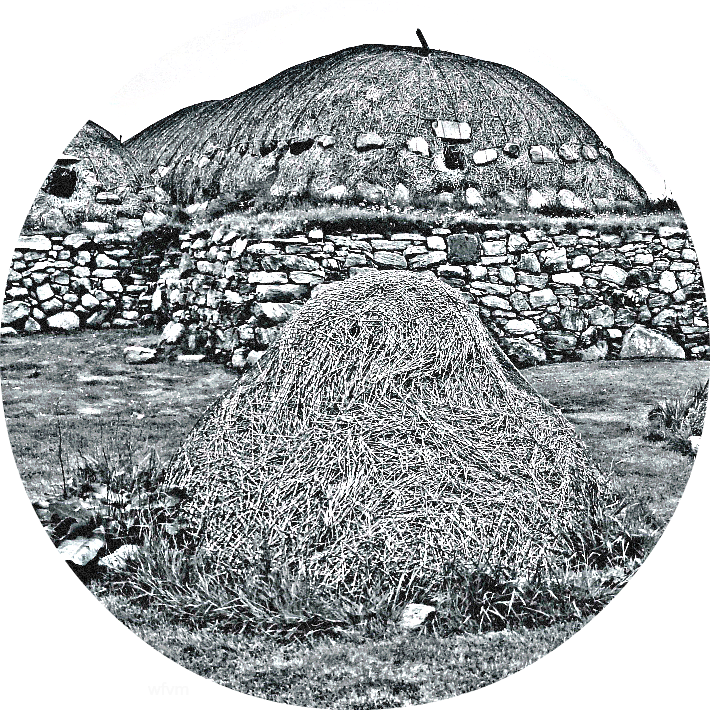
Two aspects of a blackhouse make it very different from a modern house - it was a residence for animals as well as people, and there were no chimneys. Animals living in the house had the advantage of making the house warmer and also meant that fewer buildings were needed. The smoke rising from the peat fire into the roof also had hidden benefits. It killed bugs, and the smoke-laden thatch, when removed, made excellent fertiliser for the fields. One wonders whatever it did to the lungs? This was the residence of a Hebridean crofting family and their animals until as recently as 1966.

mind your head as you enter!

The animal byre and stalls with a drain to the outside for the urine - it smells very, very, smokey in here!
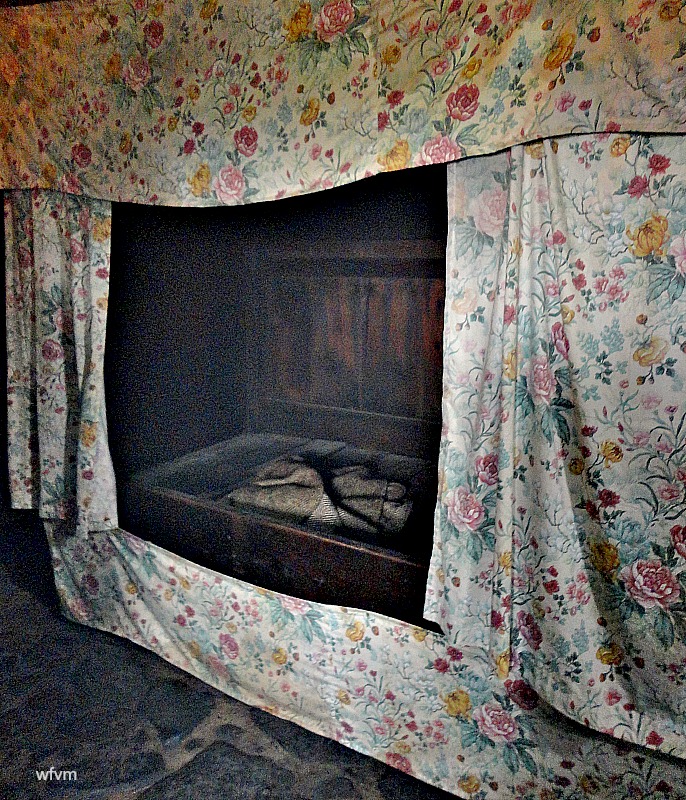
Sleeping quarters
 |
| Now I know the reason why! |

'The peat fire was the centre of family life and was never allowed to go out'

The thatch was made from oat straw, and replaced regularly. It was covered in a 'hairnet' of heather ropes, and weighted down with stones to prevent the wind and weather from blowing it away.

By the time we left the blackhouse everything about us smelt strongly of peat smoke, our hair, our clothes, and our bodies - poste haste to the hotel for us to take a refreshing shower