Showing posts with label Scotland. Show all posts

Saturday, 23 January 2016

Remembering

The University of Glasgow in 1650 - founded in 1451
University of Glasgow today showing the main building designed by the eminent Victorian architect Sir George Gilbert Scott
Scotland became our home when H was offered a research scholarship at the University of Glasgow. We were able to live on my salary whilst his research grant remained untouched and went towards savings for our first home. Times change? it would be impossible for a young couple to do that today.
We shared a flat with Mrs Wren whom we found via a 'rooms to let' notice board in the foyer of Glasgow's St.Enoch's Railway Station. A dignified lady in her mid eighties, very active and smart; her disciplined way of life had a positive influence on us. Although we were young and she was old we all got on surprisingly well. 
Mrs Wren, Jean, was the daughter of an Irish/Glaswegian labourer, one of 9 or 10 children, she was born the beauty of the bunch. As a young girl she was very aware of this, with her flaxen blond hair and tall slim figure. Many were those who wished to court her, but eventually "Mr.Right" came along. He was a very wealthy Glasgow Ship owner, a colleague of Burrell, whose collection of antiques and artworks are now housed in their own gallery in Glasgow - internationally known as "The Burrell Collection". When they married Jean's husband bought a huge house in Langbank by the River Clyde. In 1841 the Glasgow to Greenock railway line had opened and subsequently Langbank became an area where many fine houses were built. The house they owned had a tower, a flag pole atop and even had its own ballroom. 
In the 1930s she had travelled on exotic cruises and still had the wonderful dresses from that era which she would show me. 
She was indulged by her husband who obviously adored her, and showered her with specially commissioned jewels and accessories from the leading Glaswegian designers of the day. When H was away she would get out her boxes of treasures and explore them with me recounting tales and adventures from her past.
However, the 'Good Life' that she had known and shared with her husband came to an abrupt halt when he unexpectedly died, leaving her at the tender age of 40 with a daughter to finish raising. When we first met her she had been living on independent means for 45 years and that was one of the reasons why she was happy to take us into her large Glasgow apartment to help share the expenses.
Every Friday morning she would knock on our door and hand us a big plate full of her baking which she had made hours before we were even awake. She took a huge pride in her baking and the selection she gave us would vary from week to week. Sometimes scones - fruit, cheese, treacle or plain, fruit pies and cakes. At other times shortbread, scotch pancakes, 'tattie' cakes also known as Irish potato farls - it makes my mouth water just thinking about them.
On Saturday mornings, another knock, and she would hand us a big pot of her homemade wholesome Scotch Broth or Ham and Lentil Soup. It was quite a shock and a rude awakening to me when we eventually moved into our own home, and there was no one knocking on the door handing in plates of delicious food anymore.
Sometimes her sister Agnes would come and stay, she had lived a hard life much different to that of her sister. Agnes spoke with a gruff (from smoking) broad Glaswegian accent, and Jean with a much more refined one known locally as "Kelvinside" - Kelvinside being an affluent area of the city. It was very amusing for us to hear the sisters talking to one another, each with a completely different accent and tone to their voice. 
They would go off to the 'Kirk' on a Sunday morning, Agnes in her plant pot hat and rough tweed coat, and Jean in her classic black coat, large black fedora hat elegantly covering her finger waved white hair, and red silk scarf at her neck.
 via
Marcel/Finger Wave hairstyle
They would return home with scandalous Scottish Sunday broadsheet newspapers, and sit in front of the kitchen fire exclaiming to one another about how awful everything they read was. I wonder whatever they would think of the world news today? 
Jean on her 100th birthday - celebrating with a glass of champagne wearing a paper party hat. She lived until she was 105 years old. Sadly this is the only picture I have of her from a newspaper clipping which was sent to me by a friend many years after we had moved away from Scotland. 
We lived with Jean for 3 years, but finally built a bungalow in the countryside several miles outside Glasgow on the way towards Loch Lomand. It was a further eighteen months before H finished his research and eventually graduated from the university by which time our first son had been born.

Friday, 15 August 2014

Journey's End

Lewis Castle has commanding views across the waterfront at Stornoway
Stornoway is the capital of the Outer Hebrides on the east coast of Lewis. The town's true beginnings are now lost in the mists of time, but it is known that it was founded by Vikings in the early C9 under the norse name Stjórnavágr. You feel as if you are well on your way to the top of the world, next stop north across the ocean being the Faroe Islands, Iceland, then Greenland.
Harbour reflections

A bronze statue of a herring seller on Stornoway waterfront  
The island women will vote "YES" to independence. I respect their choice but personally, I am hoping the majority vote is "NO" - it would feel like a bereavement in the UK family. Scotland is a part of my life, it is where we lived for several years, and where my eldest son and youngest granddaughter were both born. Now, however, that I have travelled to these far distant islands, I do appreciate just how remote from London they are. Indeed, they are also a very long way from Edinburgh as this journey back reveals.
But what's this notice in the window upstairs? - it seems not all islanders agree - "UK OK better together - A stronger Scotland, a United Kingdom"
Gaelic street names
Colourful fishing nets drying in the sun
The ferry has arrived, and
the end of our eight island adventure. So it's farewell to this beautiful archipelago of islands formed in the Precambrian period some three billion years ago
The journey takes almost three hours back to Ullapool on the Scottish mainland
On the return journey we saw dolphins, porpoises, guillemots, cormorants and a huge variety of seabirds flying overhead - some people also spotted cute little puffins
An overnight stay near the pretty packhorse bridge in the Cairngorms, a familiar spot if you follow this blog, and then a final journey down through Perthshire
 a walk along the riverbank, then over the River Tummel back into Pitlochry
More than 5000 Atlantic salmon swim up this river each year where they negotiate a salmon ladder installed by the Scottish Hydro Electric scheme to enable them to spawn higher up the river
Salmon Ladder
next stop Edinburgh, and a quick plane ride home 

Monday, 11 August 2014

Harris & Lewis

Berneray Island, reached via a recently built causeway from North Uist, has onward ferry travel to the Island of Harris and Lewis
via
Exquisite golden beaches and azure waters, are to be found at the southern end of Harris. Hardly a soul to be seen - it is pure magic
St. Clement's church on Harris was built by the MacLeod Clan Chiefs of Dunvegan and Harris as their burial place in 1520 but the church fell into ruins following the Protestant Reformation in 1560. It was rebuilt two hundred years later by Captain Alexander MacLeod, but sadly within three years it was badly damaged by fire. In 1873 the building was restored once more by the Countess of Dunmore. Inside is found one of the finest C16 tombs in Scotland - Alasdair Crotach MacLeod's Tomb.
The tomb is carved with images from the Bible but many of the carvings also demonstrate what was important to Alasdair in his life - a hunting scene with knight and two stags; a sailing galley; a castle (probably Dunvegan); the apostles; angels; Christ upon the cross; bishops; and a carved effigy of Alasdair in Armour lies below.
Crossing the border from Harris to Lewis a ring of stones with a great central monolith was erected during 2900 - 2600 BC known as Callanish or Calanais in Gaelic. However, within 5km of the main stone circle are at least 12 other standing stone sites.
A small burial chamber can be seen within the stone circle
The chamber was encased in a cairn and cremated bones and pottery placed within
We shall never know what inspired the stones' construction, but it is generally believed that Callanish functioned as an astronomical calendar associated with the moon. Although the true story is lost in time, its legacy lives on drawing people from around the world to see our ancestors hidden history
The circle of stones and the large central monolith
However fascinating the Standing Stones are, they are not the only prehistoric site worth visiting on Lewis. Dun Carloway is considered to be one of the best preserved Iron Age Brochs in the whole of Scotland. It lies high above a crofting township and is close to a large sea loch.
Brochs are amongst Scotland's most impressive prehistoric buildings - this stone roundhouse dates from about 2000 years ago. They are found mainly in northern and western Scotland, and were probably built to reflect the prestige and status of their inhabitants. They were primarily dwelling places with family areas, but would have also provided protection from the weather and against sporadic raiders.
The double-skinned drystone walls support each other and make possible a high building of relatively lightweight form. The roofing and interior structures of brochs are much debated
An impression of how Dun Carolway may have looked and been used
The Blackhouse, Arnol, Lewis
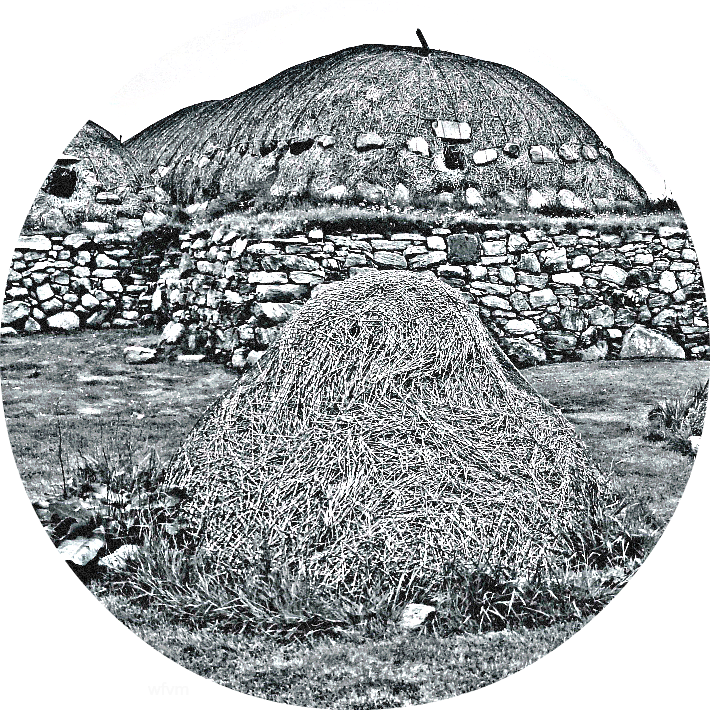
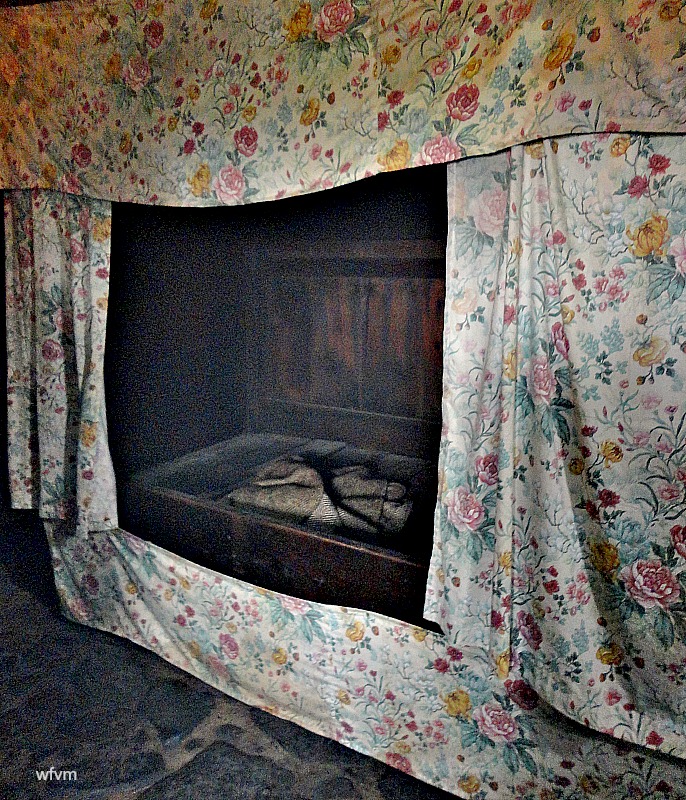
Two aspects of a blackhouse make it very different from a modern house - it was a residence for animals as well as people, and there were no chimneys. Animals living in the house had the advantage of making the house warmer and also meant that fewer buildings were needed. The smoke rising from the peat fire into the roof also had hidden benefits. It killed bugs, and the smoke-laden thatch, when removed, made excellent fertiliser for the fields. One wonders whatever it did to the lungs? This was the residence of a Hebridean crofting family and their animals until as recently as 1966.
mind your head as you enter!

The animal byre and stalls with a drain to the outside for the urine - it smells very, very, smokey in here!
Sleeping quarters
Now I know the reason why!
'The peat fire was the centre of family life and was never allowed to go out'
The thatch was made from oat straw, and replaced regularly. It was covered in a 'hairnet' of heather ropes, and weighted down with stones to prevent the wind and weather from blowing it away.
By the time we left the blackhouse everything about us smelt strongly of peat smoke, our hair, our clothes, and our bodies - poste haste to the hotel for us to take a refreshing shower

Thursday, 31 July 2014

SS Arandora Star

If you have read the previous post then this is the reason why we gazed wistfully across the sea.
When we realised how close the Island of Barra was to the island of Eriskay, it was a huge disappointment to us that sadly our schedule did not allow time for us to visit.
SS Arandora Star shown on a Waddingtons Playing Card c 1935
*******
As a young newly married couple living in Glasgow, Scotland we were introduced to a 'white' Russian lady called Vera Fisanotti (maiden name Maschova) - she was a friend of our 85 year old landlady.  
She was a widow but explained to us that her husband had been an Italian internee during World War II, and that he had been shipwrecked following deportation from Britain. His body was washed up on the shores of the Isle of Barra in the Outer Hebrides.
During 2012 I had watched a TV programme called Island Parish which was filmed on Barra. The programme vividly brought back memories of Vera and her sad contact with the island.  
I decided to do some research on the internet, and surprisingly quickly came across Vera's husband's name. I found Oreste Fisanotti on a website about the SS Arandora Star, a ship carrying refugees & internees to Canada from Liverpool.
The boat set sail from Liverpool on the 1st July 1940 and was torpedoed off the north-west coast of Ireland by a German U-boat the following morning. Oreste was among more than 800 people who lost their lives.  I also discovered that, subsequently, and following her own death in 1975, Vera had been taken back to Barra and was buried on a hilltop beside him.

Vera's life was a sad one.  She escaped from Petrograd (St. Petersburg) during the 1917 Revolution, where she was studying to become a doctor.
via 
Because of his contacts, her father, a sea captain, smuggled her on to a boat in Odessa bound for Constantinople (Istanbul). He gave her a small leather pouch containing precious stones.  As a young women arriving alone in Turkey, and unable to speak the language, she found it very frightening and confusing, so she decided to try and make her way to London.  Eventually she arrived and found work in an hotel as a chambermaid. It was in London that she met and fell in love with Oreste Fisanotti, who was also working at the hotel as a waiter, and they married.
From the day she left Russia to the day she died she had no idea what had happened to her family.  She tried to find out information about them from the Red Cross, but she was very wary of giving away too much about herself as she still had a great fear of being found by the Russians. When we met her Russia was still a closed society.
When Oreste, her only friend in all the world and her beloved husband died, heartbroken, she left London to live on the remote island of Barra to be close to his body. She lived alone on the island for over twenty years until her health deteriorated, and the doctors told her that the island was not a suitable place for her to reside anymore. She was suffering from rheumatism and respiratory problems, so very reluctantly she left the Island of Barra and moved to Glasgow.
Our Landlady in Glasgow had befriended Vera at her church and that is how we came to meet her. When we first moved into the apartment Vera was introduced to us but she was very cold towards us both. As time passed she opened up and became friendly. Later she confided that she was, understandably, jealous and anxious that we would take our landlady's friendship and love away from her.
At last together, Vera & Oreste's hilltop graves on the remote Island of Barra - on her gravestone Vera finally had the courage to publicly acknowledge her Russian origins. 
Her tragic life made a deep and lasting impression on us both.