Showing posts with label fruit. Show all posts

Sunday, 11 September 2016

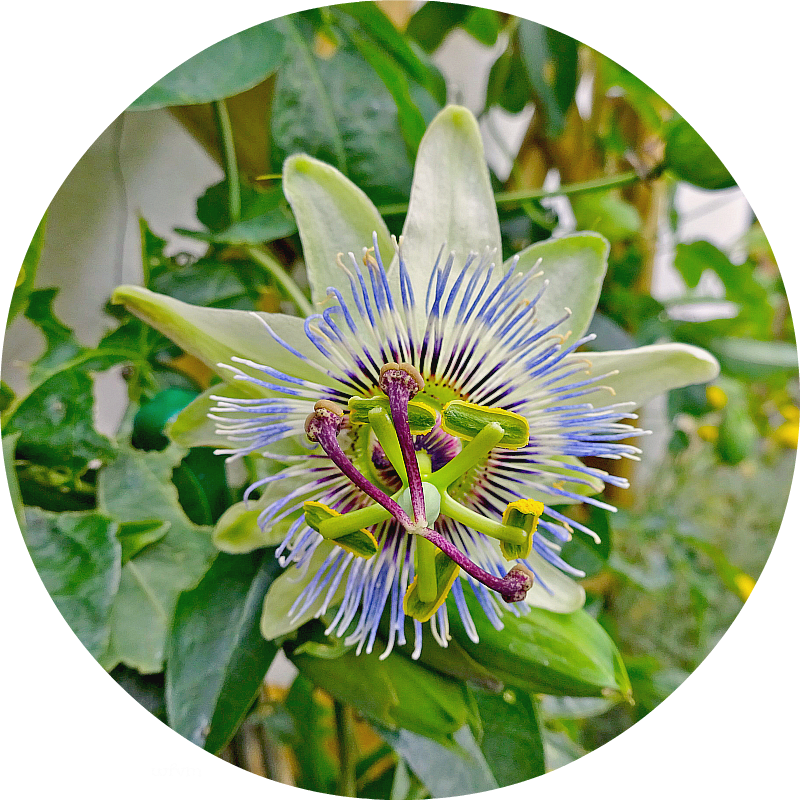
Passiflora caerulea


Given that they come from South America and have an exotic appearance it is perhaps surprising that passion flowers can grow happily outdoors here. They thrive if planted in a sunny sheltered spot especially in the southern half of the country.  Once the flowers are over they produce a fruit which is unlikely to ripen into something edible unless there is a long hot summer or the vine is planted in a glass house.
How the flower came to be named is an interesting story which some of you may already know.
In the late c15th early c16th Spanish missionaries to South America adopted the flower as a teaching tool to explain the story of the Passion of Christ to the indigenous people.
The three stigmas in the center represent the nails that held Christ to the cross - one of mine has snapped which I didn't notice when I took the photo. The five anthers represent the five wounds, the five white petals and five sepals around the edge together represent the ten faithful apostles, but exclude Judas, the betrayer, and Peter who denied Christ. The pretty filaments which can number in excess of a hundred are said to represent the crown of thorns, and their colour blue - heaven. The tendrils (not shown on my photo) are the whips used in the flagellation.

Rich in vitamins A & C I am partial to some passion fruit in my yogurt
 
It makes a tasty cheesecake, or a delicious meringue and cream roulade. There are many recipes using the fruit including jam and a curd which is made using a similar method to lemon curd

Thursday, 8 January 2015

In praise of the lemon♥

l  for lemon  +  l  for love  = lemon love♥    
lemon trees - Sicily 2012
What could be better than the juice of a lemon added to salad dressings, drizzled over fish and pancakes too? Chop some tarragon add lemon juice and pour over chicken before roasting to enhance the flavour and
via
  then imagine a delicious slice of lemon meringue pie? 
"When life gives you lemons" - make marmalade!
A bowl of lemon slices with Verbena leaves 
Top of my list in "duty free" is the fragrance of Citrus Verbena by L'Occitane en Provence. 
Picture a warm summer evening strolling in the hills of Provence surrounded by the aromatic scent of wild Verbena then add a twist of citrus from freshly picked lemons - a delicious summer fragrance all wrapped up in a bottle - spritz generously and enjoy.
(this is my personal choice I am not endorsing this product) 
 a refreshing glass of iced water topped off with lemon 
Small slices of sunshine
The three old copper engravings were done by Johann C. Volckamer published in Nuremberg during 1708-14. They are from Volckamer's Nurmbergische Hesperides. Most of the engravings in the Hesperides are devoted to citrus fruits which are positioned above views of gardens and palaces in Germany, Austria and Italy. They are a unique and delightful combination of botanical illustration and landscape.

Sunday, 29 June 2014

French Apricot Conserve

Its apricot time again - make yourself a delicious treat from the easiest recipe in the world courtesy of Perpetua.
When I saw the delicious apricots in France I regretted travelling with such a tiny cabin-class flight case. However, it was extremely liberating to carry just the basics, not even a coat or jumper, and walk straight out of the airport. 
Luckily, on my return home I discovered some lovely cheap apricots locally £2.75p per kilo same price as France, and looking just as good with a nice rosy blush to them.
All you need:- 
one kilo apricots,
750 grams sugar
wash and split apricots
cover with all the sugar &
leave to macerate for 18 hours
so simple
18 hours later and the sugar has disappeared
replaced by lots of lovely juice and now they are
ready to cook
Bring to the boil gently and
simmer for 20 - 25 mins
Put into warm sterilised jars, screw on lids
then seal the French way by turning 
jars upside down until they
cool & hey presto what could be
quicker?
except to say it tastes simply divine

Sunday, 23 February 2014

Hereford

A small group of us were invited to Hereford to visit hidden corners of the Cathedral in and around the private cloisters not generally open to the public. A further invitation was extended to visit the first floor of Hereford Library to see the private Woolhope Library belonging to the Woolhope Naturalists Field Club founded in 1851. The society is named after the Woolhope Dome, an outcrop of Silurian rocks a few miles outside Hereford. Sir James Rankin, a wealthy member of the club, offered to pay for Hereford's Public Library and Museum, and that is the reason why the club has its own room within the building. The frontage of the building is decorated with stone carvings showing fauna and flora reflecting James Rankin's interests. 
The Woolhope library has floor to ceiling shelves full of beautiful old leather bound books on many subjects including archaeology, geology, and natural history alongside a number of early manuscripts.
 via
Medlars and pears

Since Herefordshire was and is renowned for its cider and perry, an early project undertaken by the club was to document and conserve local apple and pear cultivars. To this end, the club held annual exhibitions of fruit from Herefordshire orchards, inviting leading pomologists to help identify them. These fruits were painted over a period of 10 years during the 1880s by Alice Blanche Ellis, who was a gold medal winner from the Bloomsbury School of Art, and Edith Elizabeth Bull.
Several varieties of pear

They were published in a series of books known as the Herefordshire Pomona - copies of which were on display for us to look at. The books show over 400 paintings which have been reproduced as hand-coloured lithographs. Limited editions of the catalogues were produced and they now make very large sums of money whenever they come up for sale.
Pears in the Herefordshire Pomona 
via
Whilst in the room my attention was drawn to a large black cast iron fireplace with beautiful monochrome tiles. I know nothing about the tiles, or who designed them. They were obviously made towards the end of the 19th century in the Art Nouveau style. This is pure conjecture on my part but I do wonder whether the tiles were painted by Edith Elizabeth Bull (one of the women painters of the Pomona). To my eye they carry the hallmarks of a woman's hand, and her links to Woolhope Club were particularly strong being the daughter of the Clubs President. This is just a very small selection of the tiles - they are suggestive of feminist ideals that spread amongst the educated female middle classes at that period which also happened to coincide with the women's suffragette movement. 
Painting
Commerce
Music
Chemistry
Literature
Geography
Natural History
No time to visit Hereford Cathedral's Mappa Mundi (World Map) created in the late 13th century, nor the famous Chained Library. The 16th century Chained Library is the largest of its kind in existence. In the Middle Ages books were so rare and valuable that they were often chained for safe keeping. In 1217 Henry lll revised the Magna Carta. There are only four copies now known to exist, and one of them is housed in the cathedral library. There is also a very precious 8th century illuminated manuscript known as the Hereford Gospels, but all these must wait for another visit. 
Hereford Cathedral cloisters, gardens, and houses used by the Bishop, Dean, and clergy
The name Pomona refers to the Roman goddess of fruit trees, gardens, and orchards.