Showing posts with label general. Show all posts

Friday, 13 May 2016

Daisy Time

See, the grass is full of stars, 
Fallen in their brightness;
 Hearts they have of shining gold,
Rays of shining whiteness.
Buttercups have honeyed hearts,
Bees they love the clover,
 Daisy Fairy by Cicely Mary Barker
But I love the daisies' dance
All the meadow over.


Blow, O blow, you happy winds,
Singing summer's praises,

Up the field and down the field
A-dancing with the daisies.

 by Marjorie Pickthall

Saturday, 23 January 2016

Remembering

The University of Glasgow in 1650 - founded in 1451
University of Glasgow today showing the main building designed by the eminent Victorian architect Sir George Gilbert Scott
Scotland became our home when H was offered a research scholarship at the University of Glasgow. We were able to live on my salary whilst his research grant remained untouched and went towards savings for our first home. Times change? it would be impossible for a young couple to do that today.
We shared a flat with Mrs Wren whom we found via a 'rooms to let' notice board in the foyer of Glasgow's St.Enoch's Railway Station. A dignified lady in her mid eighties, very active and smart; her disciplined way of life had a positive influence on us. Although we were young and she was old we all got on surprisingly well. 
Mrs Wren, Jean, was the daughter of an Irish/Glaswegian labourer, one of 9 or 10 children, she was born the beauty of the bunch. As a young girl she was very aware of this, with her flaxen blond hair and tall slim figure. Many were those who wished to court her, but eventually "Mr.Right" came along. He was a very wealthy Glasgow Ship owner, a colleague of Burrell, whose collection of antiques and artworks are now housed in their own gallery in Glasgow - internationally known as "The Burrell Collection". When they married Jean's husband bought a huge house in Langbank by the River Clyde. In 1841 the Glasgow to Greenock railway line had opened and subsequently Langbank became an area where many fine houses were built. The house they owned had a tower, a flag pole atop and even had its own ballroom. 
In the 1930s she had travelled on exotic cruises and still had the wonderful dresses from that era which she would show me. 
She was indulged by her husband who obviously adored her, and showered her with specially commissioned jewels and accessories from the leading Glaswegian designers of the day. When H was away she would get out her boxes of treasures and explore them with me recounting tales and adventures from her past.
However, the 'Good Life' that she had known and shared with her husband came to an abrupt halt when he unexpectedly died, leaving her at the tender age of 40 with a daughter to finish raising. When we first met her she had been living on independent means for 45 years and that was one of the reasons why she was happy to take us into her large Glasgow apartment to help share the expenses.
Every Friday morning she would knock on our door and hand us a big plate full of her baking which she had made hours before we were even awake. She took a huge pride in her baking and the selection she gave us would vary from week to week. Sometimes scones - fruit, cheese, treacle or plain, fruit pies and cakes. At other times shortbread, scotch pancakes, 'tattie' cakes also known as Irish potato farls - it makes my mouth water just thinking about them.
On Saturday mornings, another knock, and she would hand us a big pot of her homemade wholesome Scotch Broth or Ham and Lentil Soup. It was quite a shock and a rude awakening to me when we eventually moved into our own home, and there was no one knocking on the door handing in plates of delicious food anymore.
Sometimes her sister Agnes would come and stay, she had lived a hard life much different to that of her sister. Agnes spoke with a gruff (from smoking) broad Glaswegian accent, and Jean with a much more refined one known locally as "Kelvinside" - Kelvinside being an affluent area of the city. It was very amusing for us to hear the sisters talking to one another, each with a completely different accent and tone to their voice. 
They would go off to the 'Kirk' on a Sunday morning, Agnes in her plant pot hat and rough tweed coat, and Jean in her classic black coat, large black fedora hat elegantly covering her finger waved white hair, and red silk scarf at her neck.
 via
Marcel/Finger Wave hairstyle
They would return home with scandalous Scottish Sunday broadsheet newspapers, and sit in front of the kitchen fire exclaiming to one another about how awful everything they read was. I wonder whatever they would think of the world news today? 
Jean on her 100th birthday - celebrating with a glass of champagne wearing a paper party hat. She lived until she was 105 years old. Sadly this is the only picture I have of her from a newspaper clipping which was sent to me by a friend many years after we had moved away from Scotland. 
We lived with Jean for 3 years, but finally built a bungalow in the countryside several miles outside Glasgow on the way towards Loch Lomand. It was a further eighteen months before H finished his research and eventually graduated from the university by which time our first son had been born.

Wednesday, 9 September 2015

Osborne House

Today our Queen becomes Britain's longest reigning  monarch - she has now eclipsed her great-great-grandmother Queen Victoria. The following post has been languishing in my 'drafts' and today seemed an opportune moment to finally show it
♦♦♦♦♦♦  
"It is impossible to imagine a prettier spot" said Queen Victoria of her palatial holiday home, Osborne House.
A ferry journey from Portsmouth or Lymington takes you across the Solent to the Isle of Wight
Osborne House, built between 1845 - 1851 was the summer retreat of Queen Victoria and Prince Albert. A place where they could relax away from London, and spend time with their 9 children. Prince Albert designed the house himself in the style of an Italian Renaissance palazzo.
The formal gardens at the rear of the house have spectacular views across the Solent back to Portsmouth on the mainland
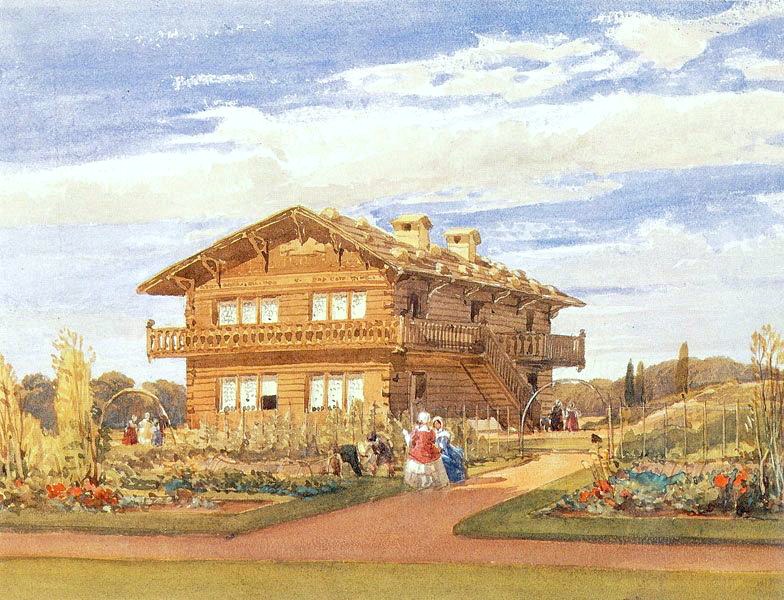
Hidden in the woods at Osborne is a little Swiss Chalet which was brought piece by piece from Switzerland and then reassembled for the royal children
Swiss Cottage - W.L. Leitch - 1855 
Known as Swiss Cottage, its aim was to provide the royal children with the experience of being 'ordinary citizens'. In the cottage garden Albert laid out rectangular beds for his children to grow their own fruit, vegetables and flowers. They wore smocks and clogs, and sold the produce to their father at the market rate. It was cooked in the kitchen at the big house and brought to the table for their family meals.
Entrance to the Walled Garden
The Walled Garden is unusual because it dates from the time of the original 18th century mansion which stood in the grounds. When Queen Victoria bought the property it was described in the particulars of the sale as being 'fully cropped and stocked with choice standard and other trees'. Once the new house was built, Prince Albert considerably embellished the garden by making the walls higher and adding ornamental decorative stonework. The portico above, from the demolished mansion, was incorporated into a handsome new entrance.
Inside the Walled Garden
This magnificent rhubarb is called 'Victoria'
The Royal family stayed at Osborne for lengthy periods each year: in the spring for Victoria's birthday; in July and August when they celebrated Albert's birthday; and just before Christmas. However, Victoria's and Albert's domestic idyll at Osborne House was not to continue. In December 1861, Prince Albert died aged just 42 years at Windsor Castle. During her widowhood, Osborne House continued as one of Queen Victoria's favourite homes, but she was bereft without her Albert.
via
Queen Victoria with John Brown at Osborne House in 1870 - Print after Sir Edwin Landseer

Saturday, 4 July 2015

Washington Old Hall


In the heart of Washington village, located near the north east coast of England, is Washington Old Hall. It stands as a testimony to Anglo-American friendship. 
This charming Hall is an historic landmark with links to the first US President, George Washington. The house predominantly dates from the 17th century but still incorporates a large portion of the original 12th century building. It was once home to George Washington's ancestors and it is from here that they took the family name. By 1860 the house had slid down the social scale. It became a working class tenement for 70 years. During that time it was rented out with up to 35 people living in appalling conditions until 1930. It was due to be demolished in 1933 but was saved by Frederick Hill, a local School Master, who formed a preservation committee to protect it.
It is a place of pilgrimage for many visitors from across the pond, and every year on the 4th July they hold a special Independence Day ceremony.
The manor house and its pretty jacobean gardens provide a tranquil oasis.
There is plenty of box topiary hedging within the garden including this beautifully manicured woven feature.
The central hall within the manor house
George Washington by Rembrandt Peale - 1850 
George Washington, the first president of the US, was born in 1732 to Captain Augustine Washington and Mary Ball. 
Captain Washington was a direct descendant of Colonel John Washington who emigrated to Virginia from England in 1656.
John was a descendant of William de Hertburn, who acquired the original dwelling on the site of the Old Hall around 1183.
The house stayed within the Washington family until 1613 when it was sold to the Bishop of Durham.

Saturday, 17 January 2015

British Treasures No 3 - Wallpainting

In 2011 a couple living in a 16th century house in Somerset were removing wooden panelling from their drawing room wall with a view to restoring and painting the walls behind. As the panelling was removed they saw eyes appearing from beneath the flaking plaster, and restoration experts were called in to remove the layers of ancient plaster. Underneath the plaster was discovered an enormous 20 foot high mural dating to around 1530. The Somerset home had once been the summer residence of Thomas Cranmer and what is now the large drawing room had been his Great Hall. Cranmer was the Arch Deacon of Taunton, Somerset who eventually became the Archbishop of Canterbury. Thomas Cranmer was the man who set up the structure of the Church of England after helping Henry Vlll break away from the Catholic Church.
Thomas Cranmer - Portrait by Gerlach Flicke 1545 - National Portrait Gallery
As the mortar was carefully removed their shock deepened when a perfect vision of Henry Vlll complete with golden crown, a long-handled orb, and a sceptre stared back at them. The once hidden wall painting is now considered to be of great national importance.
via
King Henry Vlll
By chance they recently discovered that the mural has a hidden message. A postcard the couple had commissioned of the mural fell to the floor falling with the king's head pointing towards them, thus revealing the portraits more sinister side. As they looked more closely, they realised that the devil was in the detail!
When viewed upside down or through a wine/ale glass, as it would have been in medieval days, the portrait of the king on his throne is transformed into a vision of Satan with goat's eyes and horns.
Whilst the portrait would have been an overt expression of loyalty, the hidden message suggests it was commissioned by someone with quite another view of the monarch who had made himself head of the Church of England in place of the Pope.
During the 15th and 16th century there was a great fascination with optical illusion and secret messages hidden within paintings. 
If you squint whilst looking at the bottom image Satan is clear to see.
British Treasure No.2 here 

Thursday, 8 January 2015

In praise of the lemon♥

l  for lemon  +  l  for love  = lemon love♥    
lemon trees - Sicily 2012
What could be better than the juice of a lemon added to salad dressings, drizzled over fish and pancakes too? Chop some tarragon add lemon juice and pour over chicken before roasting to enhance the flavour and
via
  then imagine a delicious slice of lemon meringue pie? 
"When life gives you lemons" - make marmalade!
A bowl of lemon slices with Verbena leaves 
Top of my list in "duty free" is the fragrance of Citrus Verbena by L'Occitane en Provence. 
Picture a warm summer evening strolling in the hills of Provence surrounded by the aromatic scent of wild Verbena then add a twist of citrus from freshly picked lemons - a delicious summer fragrance all wrapped up in a bottle - spritz generously and enjoy.
(this is my personal choice I am not endorsing this product) 
 a refreshing glass of iced water topped off with lemon 
Small slices of sunshine
The three old copper engravings were done by Johann C. Volckamer published in Nuremberg during 1708-14. They are from Volckamer's Nurmbergische Hesperides. Most of the engravings in the Hesperides are devoted to citrus fruits which are positioned above views of gardens and palaces in Germany, Austria and Italy. They are a unique and delightful combination of botanical illustration and landscape.

Sunday, 26 October 2014

Eye Glasses


A pair of French gilded scissor glasses in the Empire style c. 1805 


via

via

I was surprised to discover that the earliest historical reference to magnification for the eyes dates back to 500 BC where Egyptian hieroglyphs depict a simple concave glass lens. The earliest written record of magnification was during the 1st century AD, when Seneca the Younger, a tutor to Emperor Nero of Rome, wrote: "Letters, however small and indistinct, are seen enlarged and more clearly through a globe or glass filled with water." Nero is apparently said to have watched gladiatorial games using an emerald as a corrective lens.
Has it ever crossed your mind how devastating it must have been in the past to cope with failing eyesight without any means of restoring it? For the common man and women no aids were available. Imagine being a skilled workman - jeweller, stonemason, carpenter, a needlewomen, or an artist relying on your eyesight to earn a living. We, on the other hand, can just pop into an Opticians on any high street and be examined for a pair of prescription glasses or even buy a pair of cheap everyday reading glasses straight over the counter. 
detail from a portrait of Hugh de Provence 1352

One of the panels from an altarpiece in Bad Wildungen Church, Germany showing an apostle using lenses to read - he is in the bottom panel on the left hand side.
Known as the "Glasses Apostle" and painted by Conrad von Soest in 1404. It is considered to be one of the oldest depictions of eyeglasses north of the Alps.
St. Peter reading - Friedrich Herlin - 1466
Seated apostle holding lenses in position whilst reading. Detail from Death of the Virgin by the Master of Heiligenkreuz 1400-30
Portrait of Cardinal Fernando Niño de Guevara by El Greco circa 1600 - the glasses are hooked over the top and bottom of his ears
Portrait of Francisco de Quevedo y Villegas circa 1580 - 1645
Today it is possible to wear contact lenses and have laser corrective eye surgery. However, glasses tend to remain the norm for most people, particularly as technology has improved. Modern glasses can be a fashion statement by familiar names e.g. Calvin Klein and Gucci frames. Frames can be made from memory metal alloys that return to their correct shape after being bent, and most are now made of light weight materials such as titanium and high tech plastics.
all images via