Showing posts with label British bluebells. Show all posts

Saturday, 30 April 2022

Badbury Hill.........

.......is an area of woodland just over the Gloucestershire border into Oxfordshire. It was once the site of an Ancient Iron Age hill-fort - a defended settlement established in 600 BC. The fort originally had two banks strategically placed above one another on the highest ground in the area. Parts of the outer defence were flattened in the 18th Century, and there is now little evidence remaining. The area is particularly known today for its wonderful beech trees and beautiful bluebells that blanket the woodland floor each spring. Having never visited before we were not exactly sure what to expect.  But as we reached the top of the gently slope leading into the woods the sight that greeted us by far exceeded anything that we could have imagined - a stunning magical deep blue carpet of bluebells, stretching as far as the eye could see.

Over the years we have visited dozens of bluebell woods around the country, but none have come close to the breath taking beauty seen on Badbury Hill.

This beautiful ancient woodland is filled solely with our own exquisite native Hyacinthoides non-scripta - bluebells. They appeared to be far taller and more robust than usual, and their delicate perfume, reminiscent of hyacinths, filled the air. It is unusual to see just one species holding domination throughout an entire woodland, but here, the bluebells were in charge, this was their domain.


Can you recognise British Bluebells from  Spanish Bluebells?
British bluebells have:-
1. cream coloured stamens and anthers.
2. sweet scent.
3. narrow tubular bells with tips curling upwards and hang down one side of a purple nodding stem.
4. they are a deep blue occassionally white or pink.
5. long strap narrow leaves.
Spanish bluebells have:-
1. Blue stamens and anthers
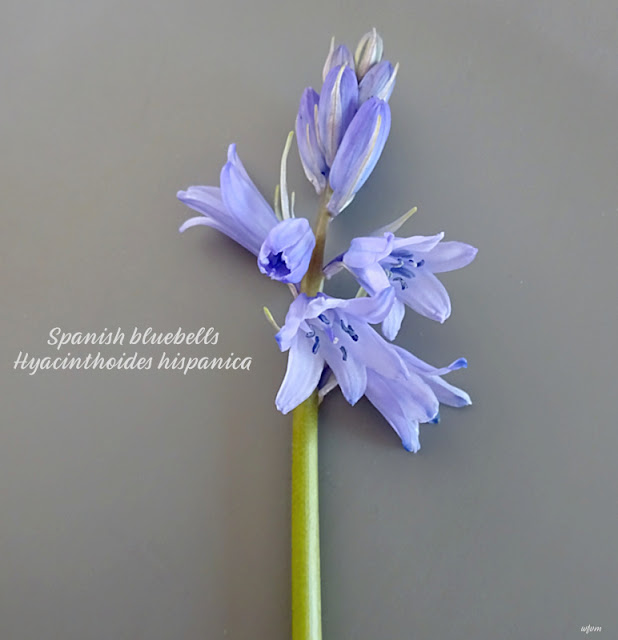
2. Pale blue flowers often pink or white. 
3. Conical open bell flowers with no scent.
4. Long broad strap leaves.
5. Flowers all around a straight stem.


Tuesday, 28 April 2020

To Woods....

Make haste if you wish to see Bluebells this year; in my area they are already past their peak - far earlier than normal.
However, whilst wandering through the wood, I was lucky enough to spot some prime specimens of Early Purple Orchids, which were much taller, and more elegant than the shorter, stubbly ones, found on our Common.
I make a point of visiting our local bluebell wood every year as I recall the words that A E Housman wrote in A Shropshire Lad, in his case regarding seeing the Cherry blossom;
******
Now, of my threescore years and ten,
Twenty will not come again,
And take from seventy springs a score, 
It only leaves me fifty more.
*****
Unlike Housman I do not have fifty more, so every year is a bonus.


Sunday, 6 May 2018

A Promise Fulfilled

On Friday morning I saw a swallow - was that a good omen? But then I recall Aristotle said 'one swallow doth not a summer make'. 
The spring weather has been mercurial, however, there's nothing I can do to change it. I have made a promise to show some English bluebells to a blogger? one who has travelled all the way from Australia - everything should be well as long as it doesn't rain.
 The Bluebell is the sweetest flower
 That waves in summer air; 
Its blossoms have the mightiest power 
To soothe my spirit's care....Emily Brontë 
Once you know what to look for it is easy to recognise a British bluebell from the rather ubiquitous Spanish ones, which are a hug threat to our native bells.
As British bluebells mature their stems become distinctly blue and droop to one side from the top, Spanish ones stand upright and are green. Our bluebells are a rich blue, Spanish ones are a paler shade of blue. British bells have cream stamens, Spanish ones are blue. The bells on the British flowers are long and narrow and softly curl at the their ends. Spanish ones have wide open bells which do not curl. The problem arises when Spanish bells, which happen to be much more vigorous, hybridise with ours. Hybridised bell flowers contain a mixture of both bells making them difficult to identify and they are even more vigorous than the Spanish ones.
I feel passionate about protecting our bluebell woods from the Spanish threat, once they are gone, they will be lost forever.
Let's continue through the wood and see a bit more blue magic.
Bluebells are mainly found in broadleaved woodlands. The trees newly emerging leaves create the perfect dappled shade that bluebells love without preventing the sunlight from filtering through.
Bluebells are a good indicator that you are walking in ancient woodland 
That's mission accomplished without any rain. The weather is so topsy turvy - now we have a heatwave!
Here's Wendy a happy blogger. 
We spent a really lovely day together.

Wednesday, 3 May 2017

A Blue Haze

They say blue and green should never be seen, but what could be more lovely than woodlands magically dressed in blue and green?


The Bluebell
 The blue bell is the sweetest flower
That waves in summer air;
Whose blossoms have the mightiest power
To soothe my spirit's care.
by Emily Bronte

The seasonal wheel keeps turning, and now that our native bluebells have carpeted the woods, Spring can give way to Summer