Showing posts with label bluebells. Show all posts

Sunday, 6 May 2018

A Promise Fulfilled

On Friday morning I saw a swallow - was that a good omen? But then I recall Aristotle said 'one swallow doth not a summer make'. 
The spring weather has been mercurial, however, there's nothing I can do to change it. I have made a promise to show some English bluebells to a blogger? one who has travelled all the way from Australia - everything should be well as long as it doesn't rain.
 The Bluebell is the sweetest flower
 That waves in summer air; 
Its blossoms have the mightiest power 
To soothe my spirit's care....Emily Brontë 
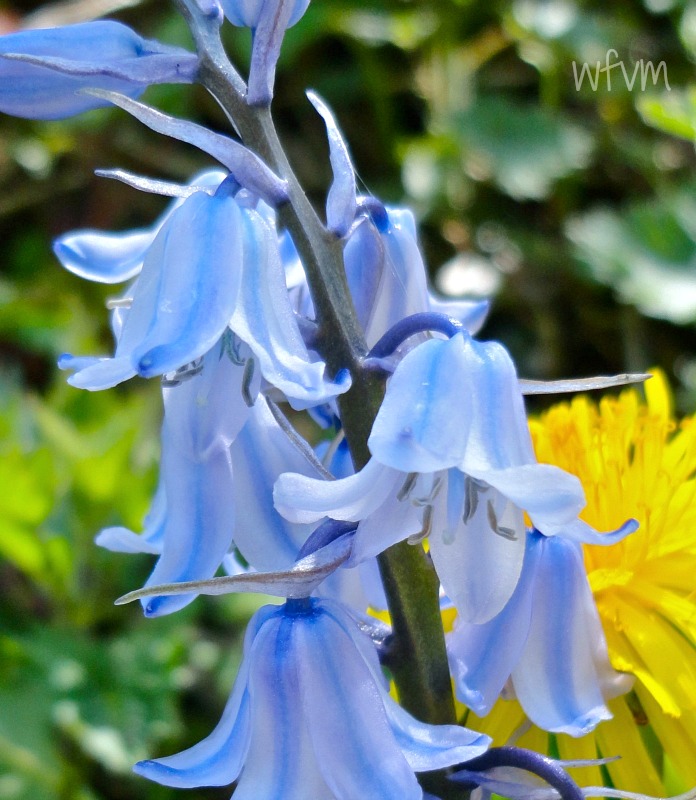
Once you know what to look for it is easy to recognise a British bluebell from the rather ubiquitous Spanish ones, which are a hug threat to our native bells.
As British bluebells mature their stems become distinctly blue and droop to one side from the top, Spanish ones stand upright and are green. Our bluebells are a rich blue, Spanish ones are a paler shade of blue. British bells have cream stamens, Spanish ones are blue. The bells on the British flowers are long and narrow and softly curl at the their ends. Spanish ones have wide open bells which do not curl. The problem arises when Spanish bells, which happen to be much more vigorous, hybridise with ours. Hybridised bell flowers contain a mixture of both bells making them difficult to identify and they are even more vigorous than the Spanish ones.
I feel passionate about protecting our bluebell woods from the Spanish threat, once they are gone, they will be lost forever.
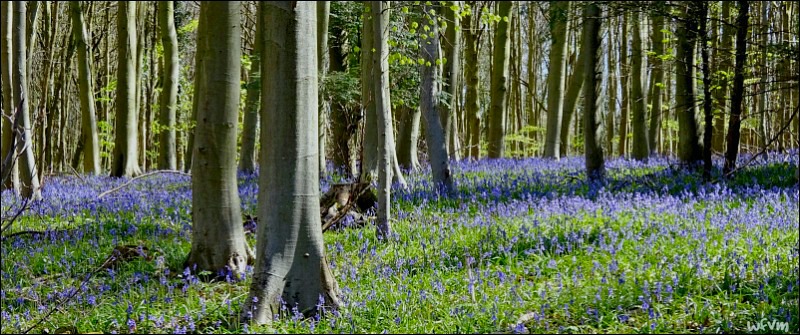
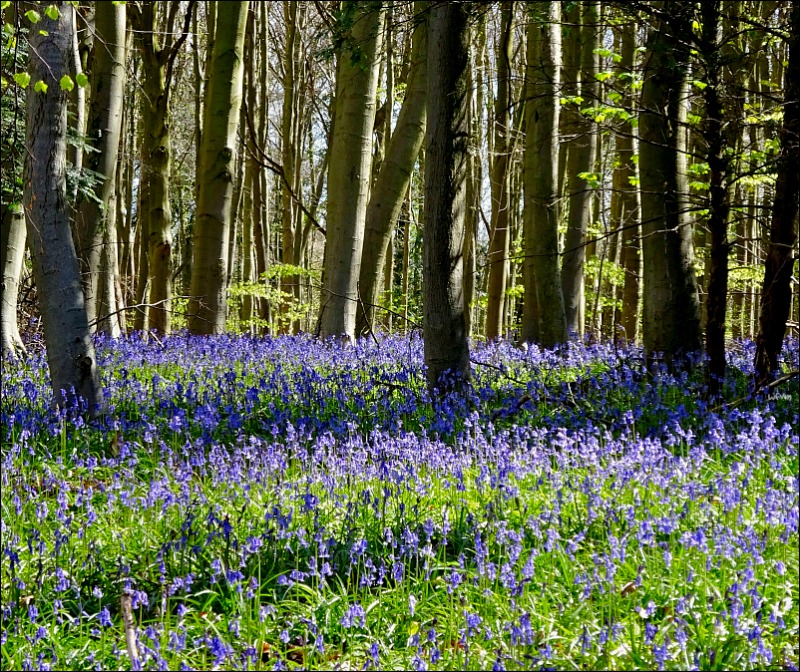
Let's continue through the wood and see a bit more blue magic.
Bluebells are mainly found in broadleaved woodlands. The trees newly emerging leaves create the perfect dappled shade that bluebells love without preventing the sunlight from filtering through.
Bluebells are a good indicator that you are walking in ancient woodland 
That's mission accomplished without any rain. The weather is so topsy turvy - now we have a heatwave!
Here's Wendy a happy blogger. 
We spent a really lovely day together.

Thursday, 28 April 2016

Cliff Top Bluebells!


I should have taken my walking boots to tackle the steep, rocky, and often dangerous cliffs that I scrambled up so easily as a youngster!!!
The cliff top bluebells may have escaped my lens, but extravagant displays of primroses caught my attention. They decorated babbling brooks, gave lacey edges to the hedgerows, prettified grassy banks along Devon's narrow lanes, and scattered their pale lemon faces all around the village churchyards. 

We stayed in Soar Mill Cove, accessible only by foot from our hotel or across the clifftops, and by canoe from the sea


Part way up the cliff - it's starting to become very rocky and dangerous -  time to turn round and go back down
past the tangled web of Gorse bush branches 

to safety
In the next post our journey takes us along


Devon's narrow roads, then across a headland 
to visit a subtropical garden

Thursday, 21 April 2016

British Bluebells

Up and down the country British broadleaf woodlands are once again magically carpeted in a haze of blue. It is widely acknowledged that our bluebells require their dappled woodland shade in order to prosper and thrive.  However, some of our bluebells also flourish on clifftops where they grow without shade and open to the elements. I first saw them growing on Devon clifftops as a child, and have no answer as to how or why they manage to suvive in what for them must be a hostile environment.
I can't answer this conundrum but I am setting off with 'high hopes' of seeing these clifftop bluebells once again.  
But before I leave I want to remind you of the differences between our native British bluebell and other bluebells generically known as Spanish bluebells.


 via
 
via
British bluebell 
Our bluebells have narrow leaves, deep blue (very occasionally white, very rarely pink) narrow, tube-like flowers, with the tips curled right back. The flowers are mainly to one side of the stem and droop or nod. Their scent is sweet, and the anthers inside the flowers are cream.
British bluebells are a protected species under the Wildlife and Countryside Act 1981 - they cannot be picked or removed from their habitat.  However, because we love bluebells in our gardens, Garden Centres have imported the Spanish variety to fulfil those desires

Spanish bluebell
Spanish bluebells have broad leaves, and pale blue (quite often pink and white), conical or bell-shaped flowers that have spread-out tips. Their flowers are all round the upright stem, have almost no scent, and the anthers inside the flowers are blue.
The Spanish bluebell is now sadly causing problems up and down the country as it is much more vigorous and can crossbreed with our native bluebell creating a fertile hybrid. They are threatening the native flower as they corrupt and dilute its unique characteristics. If you look at a bluebell to check which one it is, and you find a mixture of characteristics then you have found a hybrid. If we end up with a population of hybrids then we will loose the original genetic material forever.
If you have Spanish bluebells or hybrids in your garden and live within bee pollinating distance of a British bluebell wood then there is a serious danger that cross pollination will be taking place. 
The swallows are back
Swallows hunting insects on the wing 
We saw them swooping across clear blue skies in Malta five weeks ago, so knew that they were on their way.
They have travelled from S. Africa, over the Sahara to Morocco, down eastern Spain, across the Pyrenees, through western France before crossing the Channel to come back home to us. Here they will spend the summer and raise their young.  This epic journey will be repeated in reverse towards the end of September, and on arrival in S. Africa they will then raise yet another brood. 

Friday, 9 May 2014

The final weekend

Don't miss out on this years blue magic - make haste to your nearest bluebell woods
If you live in the UK and have not visited your local bluebell woods then this weekend could be your last chance to see the flowers this year. Time is running out - their colour is fading rapidly and seeds are already beginning to form within the flower heads.
Most bluebells are found in ancient woodlands where the rich habitat supports a whole host of species.
Some of the woodlands are even remnants of the original wildwood that covered Britain after the last Ice Age
In the Middle Ages, bowmen used bluebell sap to glue feathers onto arrows
Bluebell sap was also used to bind pages to the spines of books
The Victorians used the starch from crushed bluebells to stiffen the ruffs on their collars and sleeves
Legend tells us that a field of bluebells is intricately woven with fairy enchantments
Bees sometimes 'steal' nectar from bluebells. They bite a hole in the bottom of the bell and reach the nectar without pollinating the flower