Showing posts with label Deerhurst. Show all posts

Thursday, 5 March 2015

Deerhurst Saxon Priory - now St. Mary's Parish Church


St. Mary's Deerhurst is unique in that it still retains much of its Anglo-Saxon origins making it an exceptional survival. The founding date is 800 AD, but building work is thought to have begun much earlier. First impressions of St.Mary's are deceptive as most of the original Anglo-Saxon church, apart from the tower, is hidden behind the clerestory perpendicular windows which sit above a long row of Tudor aisle windows.
Alongside the church sits Priory Farmhouse which occupies some of the domestic buildings that were once part of the medieval priory. The Saxon apse at the back of the church and to the side of the farmhouse is ruined, and excavation work carried out in that area has revealed Roman pottery indicating a high status Roman building. It, therefore, seems logical that the church was built on top of the Roman building and that bits of it were incorporated into the church.
River Severn indicated by black arrow
Some 1400 years ago Saxon's sailed up the River Severn which makes its way through these meadows, and founded a mission on this very spot. Others continued on up the river to Tewkesbury and Worcester. The name Tewkesbury comes from Theoc, a Saxon who founded a hermitage there in the C7th. In Worcester the Saxons took over an old Roman settlement by a ford in the River Severn. The Saxons called a Roman settlement a ceaster. They called this one Weogoran ceaster, meaning people of the winding river, eventually the name became Worcester. Worcester has one of our great cathedrals and Tewkesbury has a magnificent Abbey with the finest romanesque tower in the country.
This is all that remains of the ruined apse, but behind the wall to the left is what is known as 'The Deerhurst Angel' a celebrated piece of Anglo-Saxon sculpture
The details in the head and wings of the angel are very similar to figures depicted in the Book of Cerne, a Mercurian manuscript circa 830 held in Cambridge University Library
On entering the church porch it pays to look up above the secondary entry door into the church
This limestone carving of the Virgin and Child is C9th. The central section with a shield carried by the Virgin would have contained a painted image of the Christ child. To my eye this has a contemporary feel about it reminding me of Eric Gill's work. I love the Virgin's tiny feet clinging to the ledge for support. 
This font is as rare as 'hen's teeth'. It is the finest Saxon font in existence dating from the C9th, and was carved from a single block of limestone.
In 1653 when the front was 800 years old it was discarded, and disappeared for 200 years. It was rediscovered in 1843 on a local farm where it was being used as a drinking trough for cattle. The base was also rediscovered some 26 years later when it was found at a local Inn. The two parts were then happily married back together again where they now sit in the Baptistry. The spiral pattern is not just decorative but was designed to give protection from the devil, who it was thought was only capable of moving in straight lines. This iconography is widespread in several cultures - Celts, Norse and the early Christians.
On either side of the door leading into the church are two Saxon beasts. Local legend has it that they are representations of a mythical beast known as the 'Deerhurst Dragon'. If you look closely you can still see the remains of their original paintwork
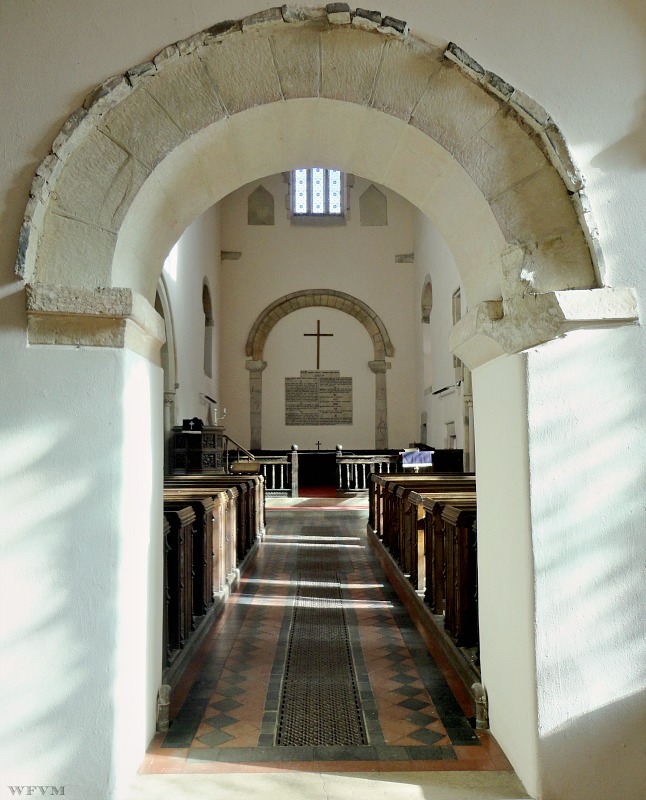
The interior of the church is very light and bright mainly because most of the windows are plain glass. The blocked Saxon arch is the same arch that can be seen outside in the ruined apse
This is a section of stained glass from the only decorated window. It is C15th medieval glass and shows St. Alphege who was born in 953 and who began his monastic life in Deerhurst, where he is reputed to have found the regime too lax. He moved away to live near Bristol and became Abbot of Bath and then Bishop of Winchester. Later, as Archbishop of Canterbury, he was captured and ransomed by the Danes, but forbade the ransom and was killed in 1012. The church honoured the millennium of his martyrdom by creating a small chapel within the church below this window.
The West wall of the Saxon tower showing numerous Saxon features - the Normans knocked out the nave walls to form side aisles, the present arcading is Early English 
I know of only one other church that has these unique Saxon triangular double opening windows
The North-West corner of the nave, formerly a side chapel, showing typical Anglo-Saxon herringbone masonry. The blocked doorway led to the apse
Details in the Early English Gothic arches

Sunday, 1 March 2015

Deerhurst

The weather has done a complete somersault, there are shafts of pale gold light playing on the windows, forget-me-not blue skies, and long shadows dancing across the meadows. It even feels warm out in the sunshine, a moment to savour, pack a picnic, and be outdoors.
Having received some interesting comments on my last post regarding the Saxon cross, it rekindled my interest in two local Saxon buildings.
Deerhurst is a small hamlet consisting of a farm and a handful of houses lying in a vale close to the mighty River Severn. It has the very rare distinction of having both a Saxon Priory, now the parish church, and a Saxon Chapel. 
Odda's Chapel is one of the most complete Saxon churches in England, and dates to the period shortly before the Norman Conquest. It was completed in 1056 by Earl Odda who was one of the most powerful of Edward the Confessor's nobles. It is just a simple two cell church composed of a nave and chancel and appears to have fallen out of use during the C13th  
During the C16th a large Tudor farmhouse was built called Abbots Court, and the Saxon chapel was incorporated into it. The chapel nave was used as a kitchen and the chancel as a bedchamber; all memory of the chapel was thus forgotten. It was undiscovered for centuries, its walls hidden amidst the rambling rooms of the farmhouse. 
In 1856 the Rev. George Butterworth, a scholar, was intrigued by an entry he found in the chronicles of Tewkesbury Abbey which described a church opposite the entrance to Deerhurst Priory.
Tewkesbury Abbey with its very tall unique Norman arch which
dwells just 3 miles north of Odda's Chapel
The Rev. Butterworth's second clue as to the whereabouts of the Saxon Chapel was even more compelling; it was the famous Saxon carved Odda's stone discovered in 1675 in a local orchard near to the Priory.
Latin translation
Earl Odda ordered this royal chapel to be built and dedicated in honour of the Holy Trinity for the good of the soul of his brother Aelfric who died in this place. Bishop Ealdred dedicated it on April 12th in the 14th year of the reign of Edward, King of the English
i.e. in 1056 in the reign of Edward the Confessor 
The above stone is an exact replica of Odda's stone which is now preserved in the Ashmolean Museum, Oxford
The North door and double splayed arched window showing Anglo-Saxon stonework. Other typical Anglo-Saxon features are the long and short stone quoins at the corner and the chapels tall proportions
The south side would have had a doorway opposite the north door but it has been blocked up
The south window still has some original oak framing, and at the bottom you can just see the arch from the north window showing
A sturdy Saxon arch divides the square ended chancel from the nave
Looking back down the nave which shows the beams that were installed to make an upper storey when incorporated into the farmhouse
A Little Sanctuary
by Admiral R A Hopwood
In the quiet Severn Valley, where it seemed as if at last 
Very peace had spread her wings on ev'ry hand,
Stood an old and battered farmhouse, where for generations past
Dwelt the yeomen and the tillers of the land.
Till in time the hand of progress came to try what could be done,
Both to modernise and renovate with care,
So they chipped away the plaster of the ages dead and gone
And they found - a little Saxon Chapel there.
***************
The Saxon Priory, now the Parish Church of St. Mary's, is a two minute stroll away from the Chapel. I will show it in the next post, it is home to some of the oldest and rarest Saxon stone work.