Showing posts with label History. Show all posts

Friday, 2 November 2018

Wootton Wawen

Visiting Wootton Wawen was to celebrate the life of our DiL's father, a well respected local farmer - his farm and land dwells in Shakespeare's Warwickshire. 
The service was held in the church of St. Peter which sits atop of a small mound overlooking the village, but it reminds us that British architecture embraces hundreds of years of history in and around so many of its buildings. 
This building was founded as a Saxon monastery in 730 by Aethelric, sub-king of the Hwicce, a province of the great Kingdom of Mercia. A copy of the Charter granting him the land for 'ecclesiastical possession' survives and is signed by Aethelbald, King of Mercia.
793 - first Viking raids
871-899 Alfred the Great
980 - Vikings ravage here in Warwickshire
1000 AD - Wootton Wawen is named after Wagen,
the Saxon thane who was lord of this farming settlement before the Norman conquest. During Viking raids the monastery disappeared and the church was damaged, but Wagen repaired and rebuilt it.
1020 - Period of monastic revival begins under Cnut and Edward the Confessor
1066 - Battle of Hastings. 
After the Battle of Hastings, all Lord Wagen's lands were given by William the Conqueror to his friend Robert, the new Norman Earl of Stafford who policed Wootton with a small garrison and a Motte and Bailey castle. The manor remained in the Earl of Stafford's family for the next 500 years. 
However, what happened to Wagen is unknown but it is thought that he may have died at the Battle of Hastings.
Robert, the Norman Earl of Stafford, gave this church to the Abbey of Conches, in Normandy. By 1100 they established a Priory here to ensure that a tenth of all the estates produce was shipped off to France. 
1135/54 - The Anarchy 
Combining England and Normandy together under William the Conqueror finally resulted in a civil war between them causing a widespread breakdown of law and order.
In order to appease and boost the local economy, the French monks endeavoured to turn Wootton Wawen into a market town.
However, in 1140 Beaudesert which is just 2 miles away, was licensed to have a market outside its magnificent castle, and with the rapid development of nearby Henley, this meant that the grand plan for Wootton Wawen came to nothing. 
1189/92 - Third Crusade
1215 - Magna Carta
1265 - Henley and Beaudesert destroyed after the
Battle of Evesham
In 1443 Henry Vl confiscated the priory at Wootton and transferred the ownership of this church to his newly established King's College at Cambridge University. Under their ownership the church was extended to become the building as seen today.  
This brief potted history simply covers the first 700 year period associated with this church. Hopefully it conveys a small insight and a sense of the history that has encompassed not only this building but all of the ancient buildings across these Isles. 
    Within the church of St. Peter is this c17th typically Jacobean style monument which is more than 150 years later than the events already mentioned. It commemorates one Francis Smith (d.1605) lying in what appears to be an extremely uncomfortable posture, but he sleeps peacefully and has done so for the past 413 years - so let's take our leave, but quietly please. 

Thursday, 20 April 2017

British Treasures No. 5


 The Coronation of Henry IV of England from the c15th manuscript of Jean Froissart's Chronicles
Princess Blanche was the eldest daughter of King Henry lV, she was the sixth child of seven. After Henry's accession to the English throne her father wanted to make important alliances in order to maintain and legitimise his rule. A suitable ally was King Rupert of Germany, who also needed to legitimise his rule too, and so a marriage was arranged between Rupert's eldest surviving son Louis and Blanche. The marriage contract was signed in 1401 and part of the bride's dowry included what is now the oldest surviving royal English crown. The marriage took place the following year in Cologne Cathedral when the bride was 10 years old. Despite the political nature of the marriage it was said to be happy. Blanche gave birth to a son called Rupert named after his paternal grandfather when she was 14 years old. Aged just 17 years and pregnant with her second child she died of a fever in Alsace.
Princess Blanche's exquisite dowry crown is now kept in the Munich Residenz.  Made of gold, enamel, sapphires, rubies, emeralds, diamonds and pearls it is considered to be one of the finest pieces made by medieval gothic goldsmiths.
The crown is first mentioned in a list of 1399 recording the movement of royal jewels in London. It is listed as being amongst a group of jewels that had belonged to the deposed King Richard II of England. It is, therefore, known that the crown was not specifically made for Blanche. 
Princess Blanche stands poised between her husband Louis lll and his second wife Matilda. At the time of this painting in 1435 Blanche had been dead for 26 years - her presence and countenance in the picture are symbolic of her death with eyes closed and hands crossed
 
I am heading off for a short break to visit some places of British historical interest
 One is a curious little building I long to see covered in symbols which conceals hidden messages 
Taking a final look back at our Spring blossom as I leave
soon the petals will float away like wedding confetti on the wind 

Monday, 27 March 2017

Cyprus......

an eastern Mediterranean island of two nations - in the south live Greek Cypriots, in the north live Turkish Cypriots. Passport controls operate at what are known as 'the green line' crossing points from one side of the island to the other. We stayed in the Turkish northern half, a less visited area revealing it's very long history at each and every turn.
This is a snapshot of places seen and visited, wildflowers enjoyed, and a guessing game for all of those who love a quiz
Bellapais Monastery
It was in northern Cyprus, in the hills above Kyrenia in the village of Bellapais that Lawrence Durrel wrote his autobiographical book "Bitter Lemons".
Deserted beaches fringed with wild Asphodelus fistulosus
Sheep safely graze - can you imagine the solitary life of a Cypriot shepherd who spends everyday of the year wandering the countryside with his flock of sheep? In Cyprus as in many other eastern Mediterranean and Asian countries, there are no boundaries enclosing the land. Sheep roam freely along the marginal areas and it is the shepherds job to protect them from harm.
On one distant peninsular live herds of feral donkeys, but they seem to have a canny way of detecting apples or oranges hidden away in pockets! Here several of the them turned up at an isolated Monastery we were visiting but luckily they received some treats

The architecture reveals a history of occupation stretching back over thousands of years


In the beginning Stone Age man arrived in Cyprus crossing the seas on wooden rafts from Asia Minor. They co-existed with dwarf animal species such as very small elephants and pygmy hippos.

Cyprus has been occupied or lived in by Mycenaeans, Phoenicians, Egyptians, Persians, Romans, Byzantines, Richard the Lion Heart, Knights Templar's, Normans, Venetians, Ottomans, and the British


Anenome coronaria
Hyoscyamus aureus
Asphodelus fistulosus

Family Convolvulaceae
Tassel Hyacinth - Leopoldia comosa - apparently the bulbs were considered a delicacy by both the Romans and the Greeks. Today on Crete, and also in Puglia, Italy, the bulbs are still eaten. Initially they are soaked in water for several days to remove any bitterness, then cooked in white vinegar before finally being preserved in olive oil - they are then used as an antipasto.  

Cyclamen persicum
Yellow Oxalis pescaprae looks wonderful scattered  over the island, but it is not something that you would want in your garden. It spreads everywhere and is impossible to remove
 Family Portulacaceae 

Ferula communis, giant fennel grows in abundance all across the island but it is inedible
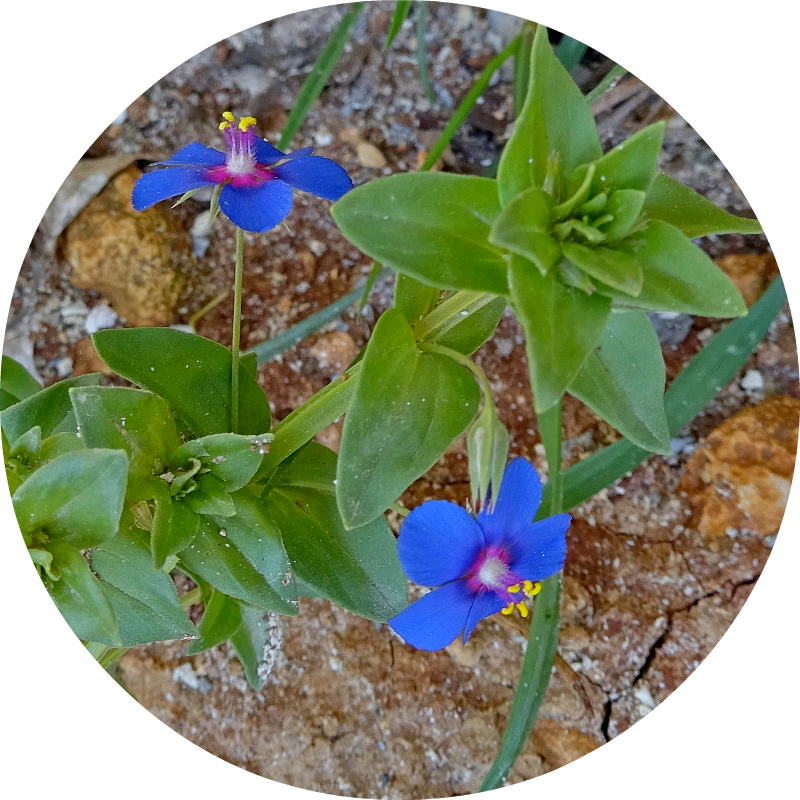
Anagalis arvensis - Pimpernel
 The Mimosa trees were just coming into blossom 
❖❖❖❖❖❖❖ 
Quiz - what is the purpose and function of 
the building below?

Wednesday, 9 September 2015

Osborne House

Today our Queen becomes Britain's longest reigning  monarch - she has now eclipsed her great-great-grandmother Queen Victoria. The following post has been languishing in my 'drafts' and today seemed an opportune moment to finally show it
♦♦♦♦♦♦  
"It is impossible to imagine a prettier spot" said Queen Victoria of her palatial holiday home, Osborne House.
A ferry journey from Portsmouth or Lymington takes you across the Solent to the Isle of Wight
Osborne House, built between 1845 - 1851 was the summer retreat of Queen Victoria and Prince Albert. A place where they could relax away from London, and spend time with their 9 children. Prince Albert designed the house himself in the style of an Italian Renaissance palazzo.
The formal gardens at the rear of the house have spectacular views across the Solent back to Portsmouth on the mainland
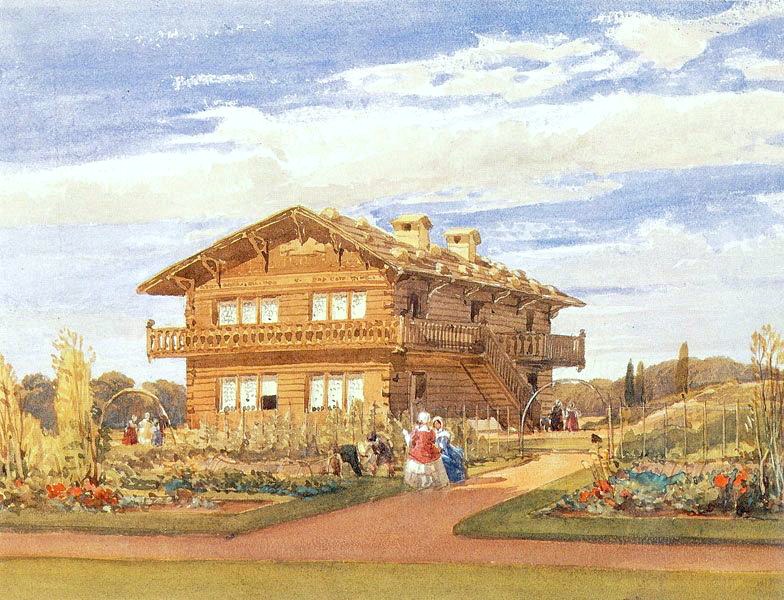
Hidden in the woods at Osborne is a little Swiss Chalet which was brought piece by piece from Switzerland and then reassembled for the royal children
Swiss Cottage - W.L. Leitch - 1855 
Known as Swiss Cottage, its aim was to provide the royal children with the experience of being 'ordinary citizens'. In the cottage garden Albert laid out rectangular beds for his children to grow their own fruit, vegetables and flowers. They wore smocks and clogs, and sold the produce to their father at the market rate. It was cooked in the kitchen at the big house and brought to the table for their family meals.
Entrance to the Walled Garden
The Walled Garden is unusual because it dates from the time of the original 18th century mansion which stood in the grounds. When Queen Victoria bought the property it was described in the particulars of the sale as being 'fully cropped and stocked with choice standard and other trees'. Once the new house was built, Prince Albert considerably embellished the garden by making the walls higher and adding ornamental decorative stonework. The portico above, from the demolished mansion, was incorporated into a handsome new entrance.
Inside the Walled Garden
This magnificent rhubarb is called 'Victoria'
The Royal family stayed at Osborne for lengthy periods each year: in the spring for Victoria's birthday; in July and August when they celebrated Albert's birthday; and just before Christmas. However, Victoria's and Albert's domestic idyll at Osborne House was not to continue. In December 1861, Prince Albert died aged just 42 years at Windsor Castle. During her widowhood, Osborne House continued as one of Queen Victoria's favourite homes, but she was bereft without her Albert.
via
Queen Victoria with John Brown at Osborne House in 1870 - Print after Sir Edwin Landseer

Saturday, 4 July 2015

Washington Old Hall


In the heart of Washington village, located near the north east coast of England, is Washington Old Hall. It stands as a testimony to Anglo-American friendship. 
This charming Hall is an historic landmark with links to the first US President, George Washington. The house predominantly dates from the 17th century but still incorporates a large portion of the original 12th century building. It was once home to George Washington's ancestors and it is from here that they took the family name. By 1860 the house had slid down the social scale. It became a working class tenement for 70 years. During that time it was rented out with up to 35 people living in appalling conditions until 1930. It was due to be demolished in 1933 but was saved by Frederick Hill, a local School Master, who formed a preservation committee to protect it.
It is a place of pilgrimage for many visitors from across the pond, and every year on the 4th July they hold a special Independence Day ceremony.
The manor house and its pretty jacobean gardens provide a tranquil oasis.
There is plenty of box topiary hedging within the garden including this beautifully manicured woven feature.
The central hall within the manor house
George Washington by Rembrandt Peale - 1850 
George Washington, the first president of the US, was born in 1732 to Captain Augustine Washington and Mary Ball. 
Captain Washington was a direct descendant of Colonel John Washington who emigrated to Virginia from England in 1656.
John was a descendant of William de Hertburn, who acquired the original dwelling on the site of the Old Hall around 1183.
The house stayed within the Washington family until 1613 when it was sold to the Bishop of Durham.