Showing posts with label Sri Lanka. Show all posts

Saturday, 26 January 2019

More Dolls

Due to the interest shown after the previous post I have been encouraged to delve into the cabinet again. 
This is a Sinhalese Devil Dancer - the different head masks have various attributions - dragons, cobras, birds etc. The Devil Dance was a unique practice in the southern part of Sri Lanka. It was performed to free a person or place from demons, evil spirits or bad luck caused by malignant spirits. It was also done to cure a patient from certain ailments. 
This doll wasn't bought when we visited Sri Lanka last June, but was purchased 40 years ago following a visit by my husband.
These two dolls came from Cuba. Whenever we could we have bought dolls made and sold by local artisans and not manufactured dolls, but of course, that is not always possible. Handmade dolls, on the whole, tend to have more character and authenticity about them.
 The majority of our dolls were actually bought by my husband when he travelled the world for the UN. Apart from enjoying seeing them the dolls were a way of giving our two sons, who were very young at the time, a sense of the people and the places that he visited.
This doll comes from Monrovia, Liberia. This handmade doll depicts a Monrovia lady carrying her baby on her back whilst crushing grain. Life In Monrovia is extremely tough, Malaria is rife, and recently they have had that terrible outbreak of Ebola.

These dolls were handcrafted in a Romanian Communist co-operative and represent various different regions in the country. They have a particular charm but belie the terrible situation in Romania for most of the population. We visited at a time when Nicolae Ceauşescu was the President, but neither we, nor the wider world, had any idea about the corrupt regime he administered until the uprising that happened several years after our visit. 

To finish some British dolls. Although manufactured in a small doll specialist company owned by Peggy Nisbet, each and every doll was individually designed by her. No longer produced, her last doll was made 20 years ago. 
I was asked the size of these dolls and on the whole most of the dolls are about 8/9 inches (20/23cms) tall - some are a bit smaller and some slightly larger.
I will not be showing any more dolls - there are far too many still lurking in the cabinet.

Friday, 12 October 2018

Hoppers

Have you eaten a Hopper?

I saw and tasted them for the first time whilst travelling around Sri Lanka.
Their appearance resembles a lacy bowl. 
They usually have an egg sitting in the bottom which is added during the final minutes of cooking along with some some spicy coconut sambal, a tasty salsa, and caramelised onions. 
They can also be filled with a mildly spiced curry made using coconut milk, chicken, or cashew nuts together with green beans or peas. Sri Lankans always have lots of different curries available at every meal time catering for all tastes. There are no problems if you are a vegetarian, or a vegan, they make lots of dishes from their huge selection of locally grown vegetables and nuts. 
Hoppers are made from dried yeast, rice flour a pinch of golden caster sugar, both coconut milk and coconut water, and then after resting, cooked in sesame oil. They are similar to a pancake and, as luck would have it, a Sri Lankan street food restaurant has just opened in our local area, so of course we had to give it a try.


The hoppers we had locally were thicker and not quite so delicate and refined as the ones we ate in Sri Lanka, but they were tasty, we enjoyed them, and they bought back happy memories of Sri Lanka - we shall definitely return to this restaurant again soon. The dish at the back is a mildly spiced coconut milk, cashew nut, and pea curry.

The chef at one of the hotels in Sri Lanka showed us how to make a Coconut Sambal by kneading and working all of the ingredients well together by hand. I made some on my return home but admit that I placed all of the ingredients into my food processor and whizzed them up altogether. Definitely not prepared authentically, but it worked, and makes a useful side dish to any curry.
Coconut Sambal
1 cup of fresh coconut finely grated
(you can use desiccated coconut but sprinkle on a little hot water or hot coconut milk and leave for 10 mins)
1 large red onion chopped
1 - 2 tspns of chili powder
juice of 2 limes
2 chopped cloves garlic
pinch of natural salt crystals 
and a grinding of fresh black pepper.

Saturday, 21 July 2018

Kandy

The origins of the Royal Botanical Gardens in Peradeniya on the outskirts of Kandy date back as far as 1371. They extend to almost 150 acres, and are filled with a huge array of Sri Lankan plant life.
We were given a small guide to the gardens, and I 
noticed a painting on the back cover done by Botanical Artist, Marianne North.  I have always loved her paintings, and enjoyed the thought that she had been here in these very gardens painting the trees and flowers in 1876. 
Orchid Houses are always interesting to visit, and this one was no exception
This happy couple kindly let me take their photograph
We had our first short splash of rain during the whole trip in these gardens, but luckily we found shelter quickly. As soon as the rain stopped the sky turned blue and the sun reappeared again.

Along the side of the river is the bamboo collection where they have the largest bamboo in the world growing which comes from Burma (Dendrocalamus giganteus). The stems attain a height of 40m and the average growth rate of new shoots is 30cm a day. 
After lunch we headed off to visit the Royal Palace in Kandy which is now the Temple of the Tooth. 
The temple houses the tooth of the Buddha which was concealed in the hair of an Indian princess and brought to Sri Lanka in the 4th century. It is an object of great reverence for Buddhists the world over.
However, on arrival we changed our minds about visiting the temple. The soles of my husband's feet had had enough. This very large building which had been the Royal Palace is filled with many rooms, courtyards, steps etc which all have to be negotiated without shoes.
As we were making our minds up on where else we should go the skies suddenly opened up and sent down an almighty torrent of rain, the second and final rainfall of the trip. The sky was blue, the sun out, but in the blink of an eye it was like standing beneath a fireman's hose continuously for 15 minutes. It took my leather shoes 5 days to dry out, and I wondered whether or not I would ever be able to wear them again. It was an experience, which made us laugh on reflection, and something we shall never forget. Just as suddenly the rains stopped, the sky turned blue, the sun appeared, and everyone continued with whatever they had been doing before.
We climbed the steep hill behind the temple to visit the British Garrison Cemetery which gave us a poignant glimpse of Empire days. The epitaphs showed that those who are buried in the cemetery were from many corners of the British Isles - Limerick in Ireland, Inverness in Scotland, Guernsey, Liverpool, and London etc. As we wandered around reading the tombs we quickly realised that the Colonial lifestyle is not all about hunting, shooting, fishing, and lavish cocktail parties. The headstones revealed to us just how hazardous the early 1800s were for those living away in far off exotic lands. "Three infant daughters each died in consecutive years of cholera"; "John Spottiswood Robertson, died 1870, the seventh and last known death of a European to have been killed by a wild elephant in Ceylon"; "Captain James McGlashan, aged 26 years old, who fought valiantly at the Battle of Waterloo, but died of malaria in Ceylon"; "William Robert Lyte 19year old grandson of Rev.Henry Francis Lyte, author of the hymn 'Abide with Me'. 
As we were strolling around the cemetery reading the tombstones, an elderly man suddenly appeared wearing a sarong. He turned out to be the caretaker of the cemetery, and he began talking to us in his eloquent BBC English. We discovered that his name was Charles Carmichael, a Sri Lankan, but with some Scottish and Indian ancestry. He told us about several of the tombs, and how he tended and cared for the graves every day of the week throughout the year. 

Saturday, 30 June 2018

Sri Lanka

"I want you to understand that the island of Ceylon is, for its size, the finest island in the world - from its streams come Rubies, Sapphires, Topaz, Amethyst, and Garnets."
Marco Polo 1292 A.D.
******
Many who visit Sri Lanka arrive in Colombo via sea or air, and my advice is to move on as quickly as you can. 
Go to the Cultural Triangle. 
Rankot Vihara in the ancient city of Polonnaruwa - the fourth largest dagoba (stupa) in Sri Lanka. A stupa is a Buddhist commemorative monument usually housing sacred relics associated with Lord Buddha. Its association is similar to that of reliquaries found in Christian churches.
Remains of the Royal Palace
The ruins of Polonnaruwa are considered the highlight of the cultural triangle. The city was the centrepiece of the Sinhalese kingdom established by King Vijayabahu l, who ousted the invading Cholas in AD 1077.

Visit the hill country in Kandy, whose verdant slopes are busy with tea pickers.
Scale mountain tops
    then visit the jungle where Marianne North the intrepid British Victorian Botanical artist came to paint the flora in 1876. If you wish to know more about her then visit a post I wrote about her here. 
 Enjoy the cloud forests,
and the coastline fringed by the Indian Ocean.
Coastal stilt/stick fisherman
Sri Lanka's southern coast was a scene of devastation when it was struck by the Tsunami in 2004 - it is estimated that over 36,000 people lost their lives.
Go to the spice gardens to see the newly cut cinnamon bark air-drying on rope made using the fibre from the local coconut trees. 
 Sri Lanka produces 90% of the worlds cinnamon from the Cinnamomum verum tree which is native to Sri Lanka and considered to yield the finest cinnamon in the world. The rolled bark keeps its scent and flavour for many, many years.
Abutilon (pictum or tigers eye?)
Enjoy seeing exotic flowers


flowers that I nurture with care grow like weeds in Sri Lanka,

Ixora coccinea 


and what about the birds - this little Bee-eater is exquisite.
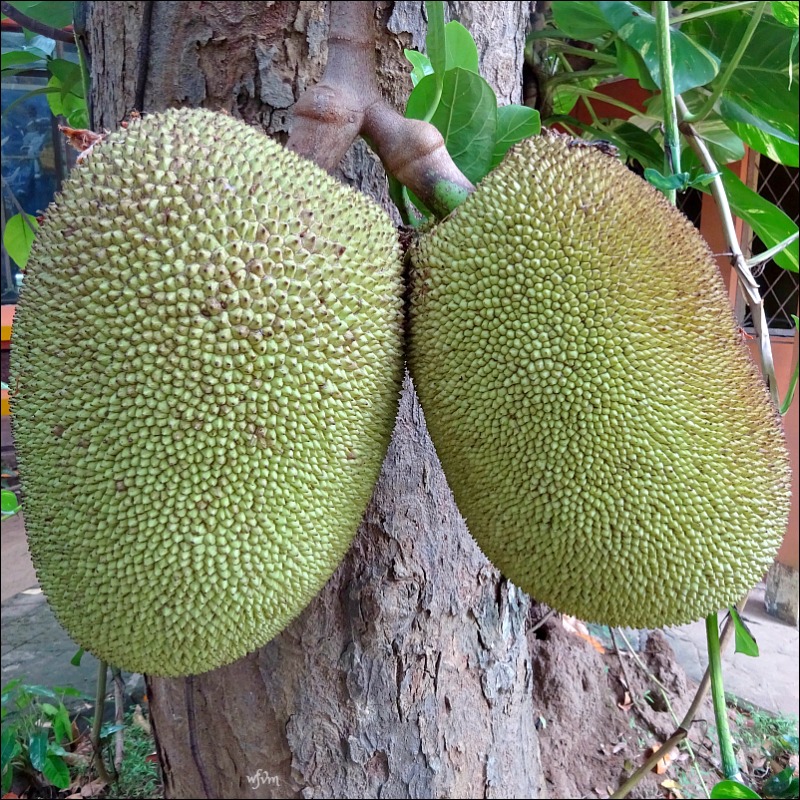
Then gaze in wonderment at some of the worlds biggest fruit.
These Jack fruit strangely grow straight out of the trunk of the tree, but you need a strong arm just to carry one of these fruits home.
Sri Lanka is smaller than Ireland, but has 26 national parks and 8 UNESCO heritage sites, all of which are representative of Sri Lanka's unique natural and historical diversity.

Next time - animals in Sri Lanka