Showing posts with label classical antiquities. Show all posts

Sunday, 15 November 2015

Where East meets West

Istanbul, a vibrant metropolis, once known as Constantinople, standing on both sides of the glittering Bosporus Straits straddling the cross-roads between Europe and Asia


Hagia Sophia


Across the centuries Hagia Sophia has been reincarnated countless times - her interior reveals her history. Used as a church for 916 years until the conquest of Istanbul by Fatih Sultan Mehmed, when she was then converted into a mosque for 482 years. In 1935 under orders from Atatürk she became a museum where Christian and Muslim symbols hang together side by side. 
Here an altar once stood, now occupied by a mihrab pointing towards Mecca
Hagia Sophia is one of the greatest surviving examples of Byzantine architecture, and is decorated with mosaics, marble pillars, and paintings of great artistic value. It is so richly decorated that Emperor Justinian proclaimed, "Solomon, I have outdone thee!" His expenditure on Hagia Sophia is said to have weighed in at 20,000 pounds of gold
Many of the notable mosaics are in the Upper Gallery known as the Loge of the Empress - the one above is the Deësis mosaic dating from 1261. Commissioned to mark the end of 57 years of Roman Catholic use and a return to the Orthodox faith. It is widely considered to be the finest in Hagia Sophia because of the softness of the features, the human expressions, and the tones used. The style is close to that of Italian painters during the late C13th/early C14th such as Duccio.
Sultan Ahmned Mosque - the Blue Mosque
The Blue Mosque, has one main dome, six minarets, and eight secondary domes. It incorporates some Byzantine Christian elements seen in Hagia Sophia along with traditional Islamic architecture, and is considered to be the last great mosque of the Classical period. The interior is lined with more than 20,000 handmade Iznik ceramic tiles, many showing different tulip designs. Did you know that tulips came to Europe from Turkey? They are native to Turkey and Central Asia.
 via
Tulips on Iznik plate c.1550
via
Procession of the guilds in front of the Sultan
at the Hippodrome, now called Sultan Ahmned Square from an Ottoman miniature - 1582
The Hippodrome was a sporting and social centre - the word Hippodrome comes from the Greek 'hippos', horse, and 'dromos', path or way.  Horse and chariot racing were popular pastimes in the ancient world and hippodromes were common features of Greek cities in the Hellenistic, Roman and Byzantine eras.
In what is now the Sultan Ahmned Square there remain a few pieces from antiquity such as the sculptural spiral bronze base shown above in the miniature and also in the photo below. However, the square is much depleted compared to the glory days of Emperor Constantine the Great when the central island was lined with bronze statues of horses, charioteers, gods, emperors and heroes. Amongst them was a magnificient statue of Heracles by Greek sculptor Lysippos, one of the greatest sculptors of the Classical Greek era during the C4th BC.
Made from bronze this spiral base once held a three-headed serpent which was brought to the Hippodrome from Delphi, Greece - the serpent's heads are not, however, lost but reside in the Archeological Museum located nearby.
  via
 When I last visited Istanbul several years ago, I discovered that the four gilded bronze horses that now reside in Venice, had originally stood on top of the imperial box in the Hippodrome used by the emperor and other members of the family. Their exact Greek or Roman ancestry has never been determined, but they were looted, from what was then Constantinopole, during the Fourth Crusade in 1204 and installed on the façade of St. Mark's Basilica in Venice.
Another survivor in the Hippodrome is the Egyptian Obelisk, the oldest monument in Istanbul
The obelisk was erected by the Emperor Theodosius in 390, but was originally set up by Thutmose III - 1479-1425 BC at the great temple of Karnak in Egypt. It is made of red granite from Aswan, between the four corners of the obelisk and this marble base pedestal are four bronze cubes used in its transportation and erection.  Each side of the marble base is engraved - on this side Theodosius l offers a victory laurel
Watch this video in full screen and you will see the obelisk, the spiral bronze base with its three headed serpent, and the four horses above the Imperial box  
Seen from the water, Beylerbeyi Palace, meaning 'Lord of Lords', is located on the Asian side of the Bosphorus. An Imperial Ottoman summer residence built in the 1860s by Sultan Abdülazis as a place to entertain visiting heads of state. Empress Eugénie of France visited on her way to the opening of the Suez Canal in 1869 and had her face slapped by the sultan's mother for daring to enter the palace on the sultan's arm. Despite this Eugénie was so delighted by the elegance of the palace that she had a copy of the window in the guest room made for her bedroom in the Tuilieries Palace in Paris. Other royal visitors were the Duke and Duchess of Windsor.
Entrance to Topkapi Palace
The Gate of Felicity in Topkapi Palace gave access to the Inner Court and what were strictly private areas. It is here that the Ottoman sultans once ruled their empire. On religious, festive days, and accession, the sultan would sit before this gate on his Bayram throne whilst his subjects and officials paid him homage
The palace is a huge, an elaborate complex which could take many days to explore. It also contains holy relics from the Muslim world including Muhammed's cloak and sword.
 At its peak the palace was home to 4,000 people
The Imperial Harem occupied one of the sections of the private apartments of the sultan; it contained more than 400 rooms. It was home to the sultan's mother, the concubines and wives of the sultan, together with the rest of his family, including children and their servants. There was no trespassing through the gates of the harem, except for the sultan, the queen mother, the sultan's consorts, the princes, and the concubines as well as the eunuchs guarding them.
Our journey continues in the footsteps of Alexander the Great to Asia Minor

Sunday, 7 December 2014

Aphrodisias - Jewel of Antiquity

Aphrodisias lies in the upper reaches of the Meander Valley, the most fertile area on the Turkish west coast. The marble quarries situated in the region gave rise to a flourishing industry extensively exploited during the Hellenistic and Roman periods. The sculpture school in Aphrodisias became famous in the Roman world, and it is where many fine examples of exquisite statuary have been unearthed. Aphrodisias was named after Aphrodite, the Greek goddess of love, a pagan Temple dedicated to her stood at the heart of the city.
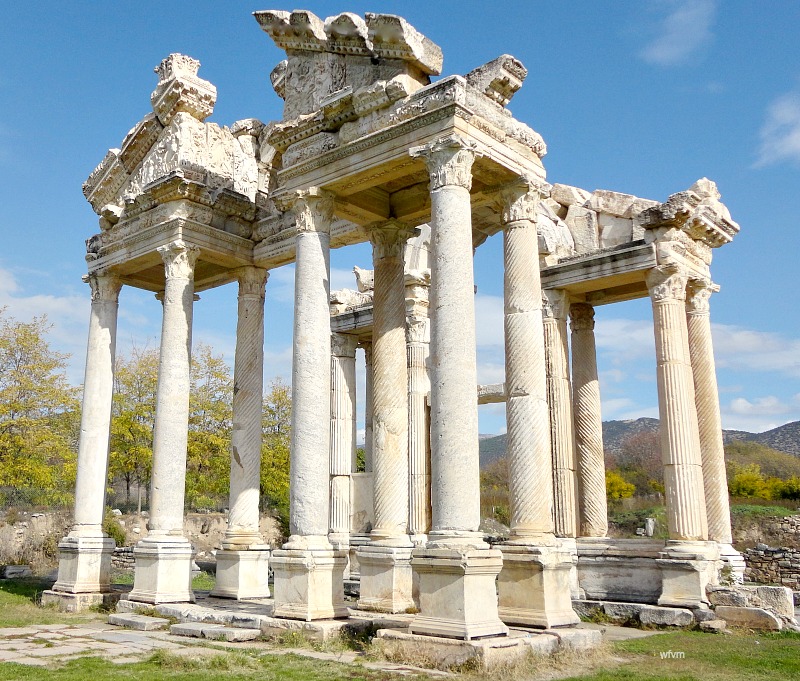
Tetrapylon, the entrance gate to Aphrodisias
The Stadium at Aphrodisias is 270 meters long and has 30 tiers of seating with space for 30,000 people. It is not only the best preserved ancient stadium in the world but also the largest. Built in the first century AD to house traditional Greek athletic contests such as running, jumping, wrestling, discus, and javelin throwing.
During the Roman period the stadium was used for gladiatorial combats and wild beast fights. Numerous inscriptions carved on the seats of the stadium provide information about the spectators. Some reserve spaces for groups of associations - The Tanners and The Goldsmiths, and others are reserved for specific individuals. Men and women from Aphrodisias and also nearby Antioch would attend the stadium 
via
The ionic order of the Temple of Aphrodite was begun in the late first century BC and completed during the reign of Augustus. In the second century AD, the temple was enclosed in an elaborate colonnaded court framed by a two storied columnar façade on the east, and by porticos on the north, west, and south
Around 500 AD the temple was converted into a Christian church. The conversion was an enormous undertaking in which many of the columns were removed from their original positions and used to extend the northern and southern colonnades. It changed the proportions of the pagan temple into an enormous church which remained in use until the Seljuk conquest in 1200 AD.
The Bath of Hadrian at Aphrodisias was originally richly decorated with marble ornamentation
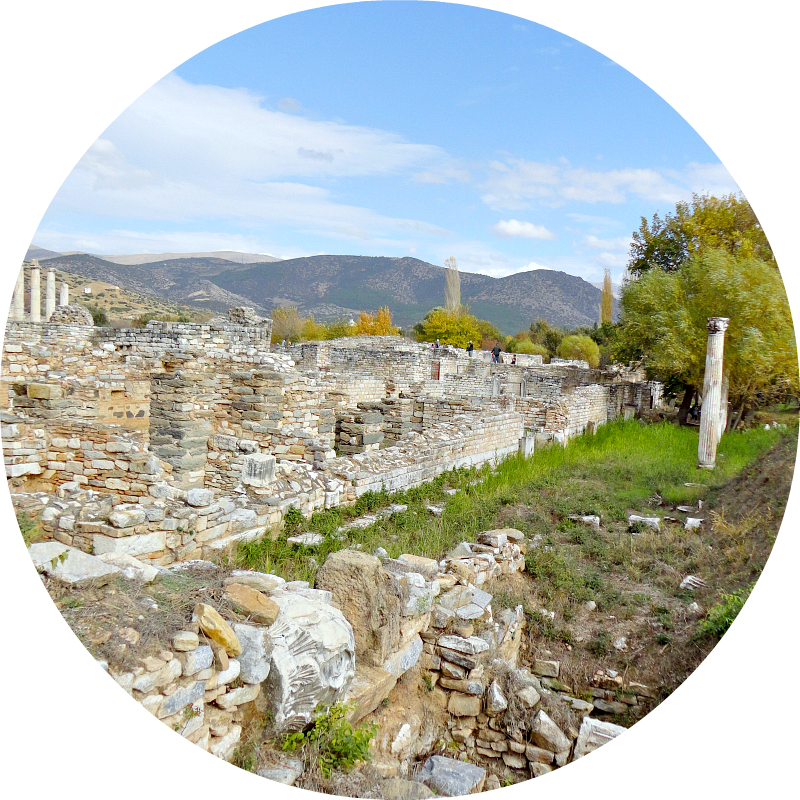
It is difficult today to appreciate the splendour of the building from the surviving unadorned sandstone and marble blocks
The South Agora was a park like public square with Ionic marble colonnades that surrounded an ornamental pool. The double wall of the pool housed pipes that carried water under pressure to feed several fountains. The north portico of the square carried characteristic mythological masks and garland friezes dedicated to emperor Tiberius AD 14-37. The west end was enclosed by the Hadrianic Baths.
This unique pool and its fountains which measures 170m has recently received funding to excavate the remaining earth fill and research its function and water system with the hope of eventually restoring it.
Antonius Claudius Dometeinos - was a local magnate, honoured by the city with a public statue at the entrance to the Bouleuterion. He wears civic dress and a heavy priestly crown, decorated with busts of Aphrodite and Roman emperors

The best preserved version of the cult statue of Aphrodite from her temple. Her head was veiled and she wears a heavy casing on which are (a) Three Graces, (b) Moon and Sun (c) Aphrodite on a sea-goat, and (d) Eros figures sacrificing
The Three Graces stand in their familiar hellenistic composition. They were handmaids of Aphrodite and appeared in this form on the decoration of her cult statue above. Their names evoke their character: Euphrosynē - Joy, Aglaia - Splendour and Thaleia - Bloom
Meleager sits on a rock tying his sandal. Below him lies a fierce hunting dog with a broad collar. On the left side a god or another hero crowning Meleager (arm missing). On the other side stands the huntress Atalante, Meleager's lover: she wears a short dress and quiver, and lifts her cloak at the shoulder in a gesture of modesty and flirtation
The two princes stand like statues, naked, wearing cloaks. The left figure holds the orb of the world in one hand, a symbol of world rule that indicates he is the imperial heir, and in the other an ornament from a ship's stern, a symbol of naval victory. They are probably Gaius and Lucius, the grandsons of Augustus, or Nero and Britannicus, Claudius' heirs
The swaddled baby Dionysos is handed from one nymph to another for suckling. A bearded Slienos gestures excitedly with his arms and taps his foot as though singing or about to dance. The scene is set at nearby Mysa in the Meander valley, where Zeus had his gifted child Dionysos, born to him by Semele, brought up in the wilds out of view of his wife Hera
Bellerophon was a Lykian hero, and was claimed as a founder at Aphrodisias. He holds his winged horse Pegasus. The carving is considered poor: the sculptor apparently learning his craft
The on site museum at Aphrodisias is exceptional with several very large rooms filled with wonderful marble statuary found at Aphrodisias - this is just a brief glimpse. The statuary gives an indication of the magnificence that was Aphrodisias.
Aphrodisias was a special city beloved by Augustus. Due to this it was exempted from paying taxes - Zoilos a good friend and a former slave of Augustus was from the city - Aphrodisias, was an artisan city whose Sculptors made statues for emperors and commanders from all over the Roman Empire
A letter written by Emperor Augustus to Stephanus - Governor of Laodicea
"Greetings.
You know my affection for my friend Zoilos.
I have freed his native city and recommended it to Antonius.
Since Antonius is absent, take care that. No burden falls upon them.
This one city, I have taken for my own out of all Asia.
I wish this people to be protected as my own townsmen.
I shall be watching to see that you carry out my recommendation to the full."

**************

This is the last post from Turkey 2014, but I am including one final image. This is for Gina at the lovely blog Art and Alfalfa who noticed it in a collage and asked if I would show it in full
Early morning in Antalya

Saturday, 29 November 2014

Ephesus

It is impossible for me to do justice to the splendours of Ephesus, a flourishing metropolis from the days of antiquity. 
We approached it from a high plain surrounded by hills and let the glories of its architectural remains unfold before us as we walked down through the city.
In the background a small theatre - the Odeum which originally had a wooden roof and in the foreground the Basilica, a municipal building where the Congress of Councillors met.
The city was originally thought to have been founded in 1000 BC but excavations carried out in the 1990s now date the original foundations to 3000 BC. 
steps leading up to the small Odeum theatre
Holding 1500 spectators this small theatre was used for concerts. It was also known as the Bouleuterion - a council chamber for Senate meetings 
One of the exit arches
Prytaneum, where religious ceremonies, official receptions and banquets were held. The sacred flame symbolising the heart of Ephesus was constantly alight in the Prytaneum
The Monument of Memmius situated on the north side of Domitian Square was constructed during the reign of Augustus in the lst century AD by Memmius, the grandson of dictator Sulla. The figures are his father and grandfather. Dictator Sulla was a hero to the Romans in Ephesus
A surviving stone base situated on the street known as Kathodos (the Way Down) carved with the symbol for physicians and hospitals - a snake entwined around a staff
On the other side of the same street is a stone base showing Hermes holding a ram and a caduceus also a symbol of medicine 
The Fountain of Trajan was constructed in honour of Emperor Trajan. It had a statue of the emperor in the central niche overlooking a pool surrounded by columns and statues.
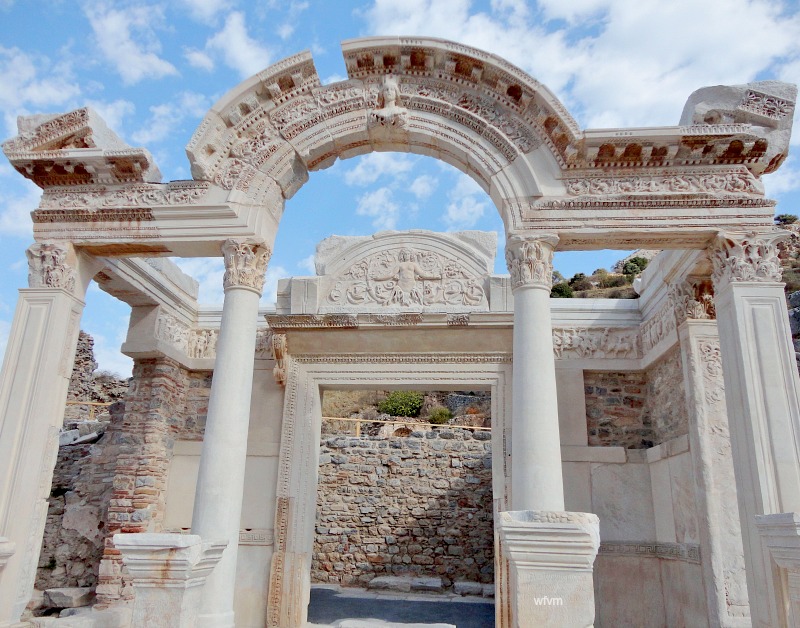
Temple of Hadrian
Built before 138 AD the temple was dedicated to Hadrian who came to visit the city in 
128 AD
Hadrian's Gate is located at the junction of Curetes Street and Marble Way
650 years ago the ancient city of Ephesus was completely vandalised and its inevitable disappearance began. Over the following centuries it became covered in detritus, rubble, shrubs, scrub land, and brambles. Travellers knew of its existence as it is mentioned in the New Testament, Acts 19:34 - St. Paul was shouted down by a mob chanting "Great is Diana of the Ephesians". A British engineer, John Turtle Wood was designing railway stations for the Smyrna railway in Turkey, and became interested in finding the remains of the Temple of Artemis (also known as the Temple of Diana). In 1863 he relinquished his railway commission and began the search. The British Museum granted him a permit and a small allowance for expenses in return for property rights to any antiquities he might discover at Ephesus. Ever since then Ephesus has been slowly reclaiming its past.
Our arrival at the outstanding Library of Celsus made us gasp with delight. It was built in the 2nd century by the Roman consul, Gaius Iulius Aquila in honour of his father, senator Tiberius Iulius Celsus Polemaeanus. The library used an ingenious method of humidity control - it had air channels running behind the niches in which precious rolled manuscripts were stored. The correct interpretation of the library is a 'heroon' as it was built over the burial chamber of the deceased father.
Artists impression of the interior of the library 
Wisdom (Sophia)
This close up photo reveals the libraries monumental scale
The statues in the niches symbolise Wisdom, Knowledge, Intelligence and Virtue. They are copies of the originals which can now be seen in the Ephesus Museum, Vienna
Virtue (Arete) 
The three-arched gate beside the library was built in 40 AD by the slaves Mazeus and Mythridates for their emperor Augustus who gave them their freedom
A walk along Marble Way
to the Great Theatre located on the slopes of Panayir Hill. It has a seating capacity for 25,000 people and is the largest theatre in the Anatolian region. Originally constructed during the Hellenistic period in third century BC it was enlarged to its current size by the Romans
It is difficult to convey the scale of the Great Theatre, but this photo must represent about one third
Arcadian Street led down to the harbour. Entering from the port, all traders and sailors would first arrive in this street. Constructed in the Hellenistic period it was restored during the reign of Emperor Arcadius. On both sides of the street were shops and galleries. I read that it was one of only three lighted streets at that time, the other two being in Rome and Antioch. I am presuming that it was lit by flaming torches. There were water sewerage channels running beneath the marble flagstones down to the sea. 
 These monumental gates along with large warehouses stood at the entrance to the harbour 
Today the area where the harbour stood is now at least 8 km away from the Aegean coast
As our walk through Ephesus draws to its close we pass the remains of the house of the Virgin Mary.  A typical Roman example of architecture which is said to combine her house and grave. It is known that she came to the area with St. John who spend several years spreading the word of Christianity. It is where they both ended their days and is a place of pilgrimage, not only for Christians, but for Muslims too. Muslims recognise Mary as the mother of one of their prophets
*******************
A Brief Time line
Early Ephesus 6000 BC - 334 BC
Hellenistic Ephesus 3rd - lst century BC
Roman Ephesus 133 BC - 2nd century AD
The city was destroyed by Goths in 263 AD
Byzantine Ephesus Emperor Constantine l rebuilt the city 4th - 14th century AD
In 1403 Ephesus was completely ruined by 
Timer-Leng, a member of the Turkish Barlas Tribe (descendants of Genghis Khan and the Mongol Empire)