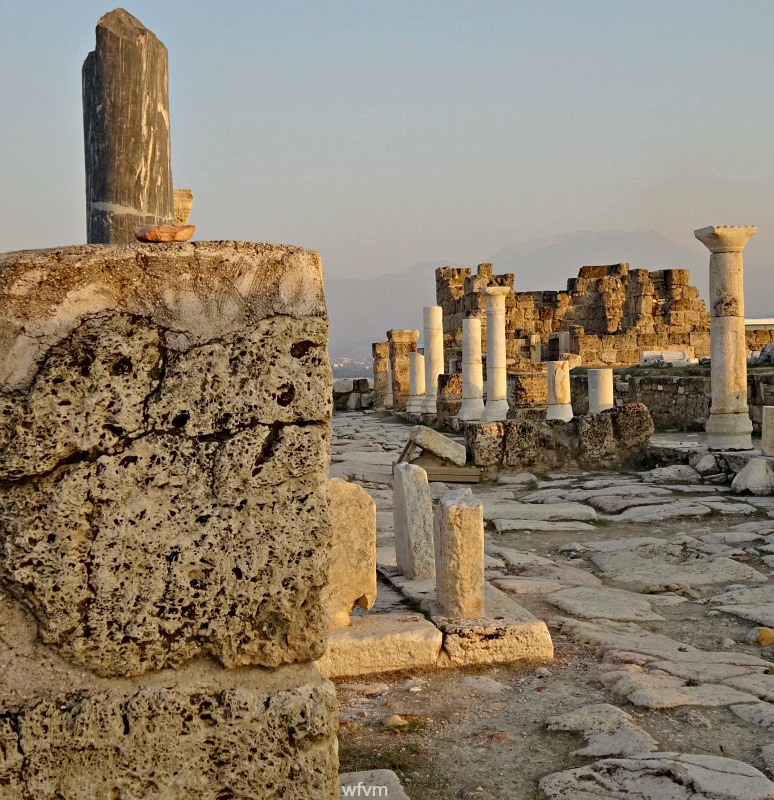
Showing posts with label Turkey. Show all posts

Thursday, 9 March 2017

Aphrodite


Greek goddess of love, beauty and pleasure - her Roman equivalent, Venus
Birth of Venus (detail) - Sandro Botticelli

Three years ago we explored the remains from antiquity of a city called Aphrodisias lying in the fertile upper reaches of the Meander Valley, Turkey
Tetrapylon - the magnificent monumental gateway which led into the city

At its heart are the remains of a great pagan temple dedicated to Aphrodite. Once there were 40 Ionic columns surrounding the temples perimeter, now most lie where they fell during severe earthquake temors in the c4th and c7th.


Birth of Venus Sandro Botticelli - 1484 in Uffizi
But we seek antiquities new as soon we head off to an island where Greek Myths tell us Aphrodite was born 


 ❀❀❀❀❀❀❀❀❀❀❀❀
In the garden this week a large male Green Woodpecker

captured through the window - males have a red moustache, females black - his beak is caked in mud from digging in our lawn looking for grubs

Some garden corners taken this week - fulfilling a request from Catherine ♡
Botticell images via   

Friday, 15 April 2016

Halva

I can't remember whether it was in Greece or Turkey that I first tasted Halva - an Arabic/Middle Eastern confection made from tahini (sesame). It tends to be eaten with a cup of coffee rather than having a biscuit, but I also recall seeing it at some hotels in Turkey served on the 'help yourself buffet table' at breakfast time. It is delicious but the flavour and texture are both difficult to describe, and although it is a confection it is not overly sweet. The Halva I like is filled with nuts - pistachio or almonds, but it comes in many different flavours.  
I had been unable to track it down in the UK, that is, until I noticed that Lidl were having a "Greek Week" and there on the shelves blocks of Halva appeared. They had three types: chocolate flavoured, Macedonian honey, and roasted almonds. I noticed that they still have some blocks left this week as I suspect that many people do not know what it is. I am just enjoying the last slice of halva with a cup of coffee, but will be watching out for it again during their next "Greek Week".
p.s By the way I am not in cohoots with Lidl 

Tuesday, 8 December 2015

Laodicea, Turkey

Laodicea, in Asia Minor, was the seventh and final church to receive a letter from the Apostle John. At that time the Christian community in Laodicea was considered to be 'rather luke warm' and this was reflected in the message received 'Behold I stand at the door and knock'. I am reminded that when my granddaughter was at Oxford University, her college, Keble, owns a painting done by Pre-raphaelite artist, William Holman Hunt - The Light of the World. This painting is based on that message sent to Laodicea in Revelations 3:20 
William Holman Hunt - The Light of the World
Excavation work at Laodicea began about 10 years ago, and it is anticipated that when completed its importance and interest could equal that of  Ephesus. 
Being a significant Christian center there was great excitement when archaeologists discovered a church structure built during the reign of Constantine (306-337) using ground penetrating radar. The church is in the process of being unearthed and the cross shaped marble baptistery appears to be one of the oldest and best preserved ever discovered.

via 
Stained glass window painted by C15th glazier and painter - John Thornton
The Seven Churches mentioned in the Book of  Revelations are shown in this medieval East Window at York Minster - St. John in the lefthand corner is being instructed by an angel to write to the seven about his vision. The seven churches were in Ephesus, Smyrna, Pergamon, Thyatira, Sardis, Philadelphia, the seventh and final one being Laodicea
We arrived in Laodicea during 'golden hour' just before sunset and had it almost to ourselves
The city was laid out on a grid system, and rather topically this is 'Syria Street'

Eventually the great temple that stood here - a Prostyle Temple of Corinthian order surrounded with porticoes, will be rebuilt 
The excavated remains lie scattered across the site, all are numbered and logged - I imagine that it will take years to both reassemble and reinstate the missing parts
These pillars are in the process of being reassembled with inserts of new marble. The new marble is a different colour which has been done purposefully in order to show an honest reconstruction
 So far over 3,000 ancient artifacts have been excavated in the city, amongst them the sculptured heads of Augustus, Dionysus, Aphrodite, and Zeus
As we left the site in fading light one of the cranes was still busily lifting pieces of stone ready for reassembly. In years to come a Museum will be built here, and filled with the many valuable sculptures and artifacts discovered todate. This raises the prospect of an exciting and fascinating archaelogical experience for visitors in the future .

Thursday, 19 November 2015

The Wind Brought Wealth to Troy

The ancient city of Troy engaged in extensive trade as far back as the Bronze Age. The city commanded a strategic point at the southern entrance to the Dardanelles, a narrow strait linking the Black Sea with the Aegean Sea via the Sea of Marmara. It also commanded a land route that ran north along the West Anatolian coast and crossed the narrowest point of the Dardanelles to the European shore. However, what made Troy's position so powerful was the wind. At the entrance to the Dardanelles, a strong wind prevails from the northeast; in addition, a powerful 5-knot surface current flows from the Sea of Marmara into the Aegean Sea. The flat bottom, square rigged ships of the Bronze Age had to lay up at Troy and wait for favourable southerly winds, which blow for only a short period during the summer. The Trojans were able to charge not only tolls for passage through the Dardenelles but also mooring fees. Due to the citys location much business was transacted; goods were exchanged, ships unloaded and reloaded making the city an important trading center between east and west and, in the late Bronze Age between the north and south.
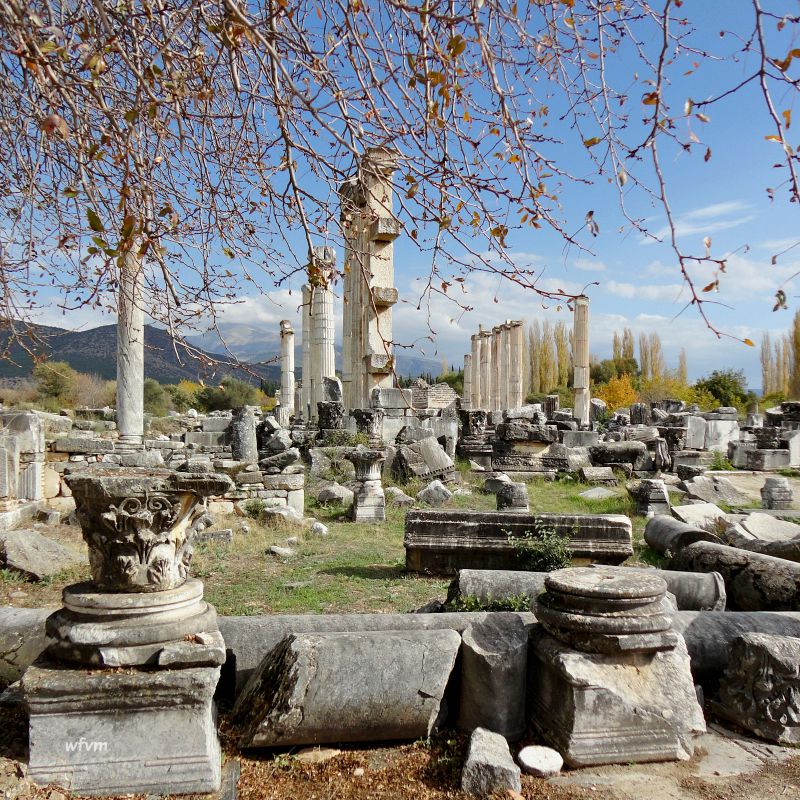
On this picture it is possible to see just how far away the sea has receded from what was the ancient city of Troy

A continual stream of vessels passes through the Dardenelles Straits today predominately travelling to and from Russia 
The Legend of the Wooden Horse
The war between the Greeks and the Trojans was in its tenth year. The Trojans rejoiced when they awoke one morning to find that the Greek army had sailed away, but they had left behind a strange gift - a giant wooden horse. The Trojans were divided - should they set fire to the statue or should they honour and worship it? Some wise old men realised there was something not quite right and advised setting fire to it. Others warned that if they did so the gods would be angry as the horse is dedicated to Athena, the great goddess of wisdom, and they did not wish to feel her wrath.
Thinking it must be a sacrifice the Trojans opened up the city gates and brought the horse inside and then began to celebrate. The Trojans did not realise that it was a ploy and that Greek soldiers, hidden inside the horse, were now amongst them in the city. After all their celebrations the exhausted Trojans slept, and then quietly a trapdoor hidden within the horse opened enabling the Greek soldiers to creep out. They opened the city gates to admit their colleagues, who had not sailed away, but had concealed themselves in the countryside. They set fire to the city and by dawn the once splendid city of Troy was nothing but a smoking, silent, ruin, and all the Trojans were dead.
There are 9 historical layers of different cities built one on top of another at Troy dating back over 5000 years -  from a Bronze Age settlement to the Greco-Roman metropolis that disappeared around 400 AD.
The walls of the acropolis have now been identified as the site of the Trojan war which took place during the late Bronze Age. The siege of Troy by Spartan and Achaean warriors from Greece has fired the imagination of writers and poets for thousands of years, probably the most familiar being that of Homer. After intensive reading of Homer's Iliad, wealthy German merchant Heinrich Schliemann, an amateur archaeologist, became convinced that Troy was to be found in the south of the Dardanelles, and he began excavation work there in 1871. Two years later he succeeded in making one of his most important discoveries - a discovery which he hid from the Turkish authorities - he had discovered the 'gold of Priam' consisting of more than 1,200 pieces of gold jewellery and ornaments. In 1880 he presented them as a gift to Emperor Wilhelm l, but in 1945, the 'Gold of Troy' was brought from Berlin to the Soviet Union as part of the spoils of war. It was believed to be lost until it turned up in the 1990s in Moscow's Pushkin Museum. Soon after, it was exhibited and made accessible to the public for the first time.
 
Sophia, Schliemann's wife, adorned in some of the gold he excavated in Troy. 
The citadel's ring of walls stretches out on both sides of this ramp
It was not easy for me to understand the different city layers and remains of 5,000 years of habitation but nevertheless there is an overwhelming sense of Troy's long history as you view these massive walls.   
The Roman Odeion, a small theatre principally for musical performances 
The South Gate leads into the 6th historical layer of Troy which was probably the principal entrance to the citadel. Only the roadway survives today. It ran in a straight line up into Troy being entirely paved with stone slabs. In the middle of the road a drainage channel, thought to be from the 7th historical layer, runs beneath the paving stones.
via
Should you arrive here, as Alexander the Great did, carrying a copy of Homer in your hand, you will surely hear the echo of battle cries from Agamemnon's fleet across the Trojan plains. 
Footnote - Schliemann also discovered this golden funeral mask of Agamenmonon at Mycenae, Greece, three years after he found the Gold of Priam

Thursday, 12 November 2015

To Autumn

"skeins of mist like translucent silk, bending and unbending in the headlight tunnels"
John Geddes
"There is something incredibly nostalgic and significant about the annual cascade of autumn leaves" Joe L. Wheeler
"Autumn carries more gold in its pocket than all the other seasons" Jim Bishop
"Autumn is a second spring when every leaf is a flower" Albert Camus 
"I cannot endure to waste anything so precious as autumnal sunshine by staying in the house" 
Nathaniel Hawthorne, The American Notebooks
Season of mists and mellow fruitfulness - John Keats
Arrived back from Turkey a few hours ago - thank you for all your kind comments on the previous post

Friday, 30 October 2015

November Sojourn

Aphrodisias

The Celsus Library at Ephesus built between A.D. 100 and 110 by Gaius Iulius Aquila for his father, the senator Tiberius Iulius Celsus Polemaeanus.
Now that November is almost here it's time for us to take our leave. We look forward to renewing our acquaintance with one of the great cities of the world. Like Alexander the Great before us, our travels will then take us to a place known from Classical sources as Asia Minor - the setting for a legend described in Homer's Iliad and the scene of a ten year long war. We shall visit a recently excavated ancient city where the last of St.John, the Apostle, sent is seventh of the seven letters - Revelations lll: 14 - 22 which includes "Behold, I stand at the door and knock". 
Cappadocia 
via
Pamukkale
I wonder if we will discover anymore surreal landscapes?

From past experience, November is a lovely month
  the sunshine helps foreshorten our British winter and
we have always enjoyed delicious food together with a gracious welcome

Thursday, 21 May 2015

Srinagar and its Traditional Crafts


Hand embroidered Kashmiri Crewel work is a very long standing traditional craft in Srinagar. It is very similar to that seen in England commonly used during the Jacobean period for bed and wall hangings, and on the clothing worn by the rich. The Bayeux Tapestry was also made using hand embroidered crewel work. Crewel work was reintroduced in England by Wm Morris during the Arts and Crafts period, and it experienced another revival during the 1960s. The Crewel embroidery style and designs are thought to have travelled from Persia (Iran) to Kashmir then to Egypt, Greece and Rome, before travelling to England during the Roman conquest. 
I wrote a post here about the actual origins of the generic term 'Paisley' in connection with Kashmiri shawls and stoles but never imaged that one day I would visit Kashmir.
For 20 years, until 2012, Srinagar and Jammu have been closed areas to British visitors. Srinagar is Kashmir's summer capital, their winter capital being Jammu. Travel was not permitted by the British Foreign Office due to Kashmirs position next to several borders of unrest and conflict - Pakistan, China/Tibet and Afghanistan. Although others can travel up into the mountains, for us, it is still not permitted by our government.
Shah Hamdan is a richly coloured beautiful old Srinagar Mosque made of wood, built in 1400 with a distinctly Nepalese feel to it. Non Muslims are not allowed inside but we were permitted to take photographs through the grills 

An old lithograph of Shah Hamdan Mosque dated 1847

Mosque Chowkidars (watchmen)
The Mughal emperors who ruled India for nearly 300 years arrived in 1346 from Samarkand, Uzbekistan and Central Asia. They greatly favoured the Persian art of Papier-mâché and introduced the craft to Kashmir - a rich tradition of craftsmanship which continues today
I have looked up the history of Papier-mâché and believe that Shah Hamdan Mosque in Srinagar is unique. It is possibly the only building in the world to be covered with Papier-mâché both inside and out. 
The entrance porch ceiling
In Kashmir they decorate with designs of small flowers and foliage favouring what we know as the 'Florentine' style
Carved wooden entrance door
The Papier-mâché inside the mosque has far brighter colours than my photos indicate
The weaving of pure silk and fine pure wool carpets is another long standing tradition in Kashmir also introduced from Persia (Iran). Only Kashmiri men weave the rugs and carpets in contrast to Turkey where all the weaving is done by women
Srinagar stands on the Jhelum River and has a distinctly Central Asian flavour; when heading south from Srinagar it is often referred to as 'returning to India'. Two weeks before we arrived they had severe flooding and you can still see the debris caught up around the bridge
 Time to return back along the waterways to our houseboat