Showing posts with label Bristol. Show all posts

Monday, 27 August 2018

The 'Matthew'

At 70 feet long, designed and built in Bristol, and with a well chosen crew of 18, the 'Matthew' sailed from the mouth of the Avon on the 20th May 1497. 
Above is a conjectural reconstruction of the 'Matthew' which John Cabot sailed from Bristol in search of new lands. 
At the end of the c15th knowledge was scarce, it is difficult for us today to appreciate or comprehend just how ignorant and illiterate the majority of people were. Nevertheless, even from humble beginnings great persons did emerge.
Giovanni Cabboto - John Cabot, was born in Genoa in 1450, the son of a spice merchant. By the time that he was 11 years old his family had moved to Venice, and there the young John worked in his father's shop. However, during his mid 30s he spent several years learning to became a skilful mariner. Knowing that spices came from the East, and that it was possible, though not proven, that the world was round he was convinced that by sailing westwards he could explore and tap into the riches found in the orient.
In 1495 Cabot came to Bristol hoping to find a sponsor for his voyage and was introduced to a group of merchants who were keen to expand their trade.
Impressed by Cabot they arranged an audience for him with King Henry Vll in London, and on 5th March 1496, Cabot secured letters patent from the King (a letter of authority to make a voyage and claim lands on behalf of the monarch).
via
Thirty-four days after sailing west from Bristol, Cabot sighted land. The exact location is disputed, but it is thought that it could have been southern Labrador, Cape Breton Island, or mainland Nova Scotia, but many consider that it was 'New-Found-Land'. When Cabot went ashore, he reportedly saw signs of habitation but no people. However, he returned back to Bristol along with several pieces of evidence from his voyage amongst which was a needle for making nets, a snare for catching animals and the complete jawbone of a whale. Cabot had not discovered a passage to Asia as was his initial intention, but instead discovered a continent - a continent that most of the world had no idea existed.
Cabot set off again the following year in February 1498, but this time he had five ships and 200 men. His intention was to continue westward from his first landfall until he reached the island of Cipangu (Japan). Several weeks later one of his ships, which was badly storm damaged, limped into coastal waters off Ireland. However, Cabot, and the other boats were never heard of again, and it was presumed everyone perished at sea. 
It was a lovely sunny afternoon to walk along the water front whilst passing some interesting vessels on the way - this canal boat has been decorated in an Art Deco design.
you can take a trip on a ferry, 
 or visit a really great ship, a jewel in Britain's maritime history, built to great acclaim in 1843. She returned back home to the dock of her birth almost 50 years ago having lain on the seabed for 33 years, some 8,000 miles away.
Having now been fully restored to her former glory, we had no time for a visit as our granddaughter had invited us to her home for supper. The story of this great ship will have to wait for another visit.

Saturday, 27 August 2016

In the Company of Angels


 The living and the dead,
The awake and the sleeping,
The young and the old
are all one and the same.
~ Heraclitus ~

Arnos Vale is a 45 acre green oasis of peace and calm in the middle of Bristol - a haven for wildlife - a place of 'heavenly works' created by man for man.
Almost 200 years ago the need for new burial places coincided with a trend for creating 'garden cemeteries'. The movement owed a lot to the fashion for all things classical, but was also inspired by Père-Lachaise Cemetery created in 1804 in Paris. By the time Arnos Vale Cemetery was opened in 1839, garden cemeteries were being established in other cities across England. The best known of these is London's Highgate Cemetery which has some of the finest funerary architecture in the country.

It is interesting that much of the religious symbolism in the cemetery that was so familar and known to our ancestors is often completely lost on us today.
A typical example above shows a pelican feeding her young. In medieval Europe, the pelican was thought to be particularly attentive to her young, to the point of providing her own blood by wounding her chest when no other food was available. As a result the pelican came to symbolise the Passion of Christ and the Eucharist, usurping the image of the lamb and the flag. There is a hymn by St Thomas Aquinas where the penultimate verse describes Christ as the 'loving divine pelican' able to provide nourishment from his breast". 
A cross is the most common furniture architecture in a cemetery closely followed by an urn. The urn  represents an ancient symbol of death and the drapes symbolise sorrow and passage from one existence to another.
In funerary architecture the white lily represents the idea of purification of a departed soul - sometimes you will see a broken lily which indicates that the person died before their time

This unusual tomb for Raja Rammohun Roy Bahadoor is based on one from Bengal in a style known as 'chhatri' - an elevated architectural Indian dome.  A commemoration is held here annually attended by Bristol's Lord Mayor together with the Indian High Commissioner and admirers of Raja Rammohun Roy Bahadoor, a noted social reformer and the "Founder of Modern India". He was visiting Britain as the representative of the Mugual Emperor, Muhammad Akbar ll when he fell ill with meningitis and died in Bristol.
The cemetery is a unique time capsule of the Victorian and Edwardian period where the listed memorials and gravestones pay tribute to more than 300,000 people from Bristol's past. The Victorians would lease family graves 'in perpetuity' or for 125 years without giving any thought as to who would pay for their care after that. 

Wandering around the area is redolent of a time long gone where thousands of family graves have been effectively 'abandoned' over the years meaning that there are no funds for the upkeep of the graves. Nature has stepped in - trees push their way through the tombs which are in turn covered in ivy and brambles.
 The Victorians spent large amounts of money on their tombs. This enormous obelisk would have cost over a £1000, representing £65,000 in today's money. 
 What is the fate of this sylvan Arcadian landscape?


Members of the Friends of Arnos Vale have set up a trust to restore and protect the cemetery, and an open competion has recently been won by an American design team from Columbia University's Graduate School of Architecture who submitted radical plans for its future. Their vision is to construct a constellation of lights among the woodlands around the cemetery, with each beacon glowing in remembrance of an individual. It is thought an urn containing the cremated remains would be embedded within the structure of the lamp, together with a digital depository of their online existence

Whilst respecting and preserving its past, could these radical plans be the future of Arnos Vale?  Personally I am not convinced that this is necessarily the way forward. However, it is imperative that this historic landscape with its Grade ll* listing should be preserved, and prevented from further degradation.

Tuesday, 2 September 2014

An Engineering Masterpiece

If you go down 
to the woods today
You're sure of a big
Surprise
Could it be a teddybears picnic?

via
illustration by Molly Brett

No, its
a
bridge that is
exactly
150 years old
Designed by Isambard Kingdom Brunel (1806-1859)
via
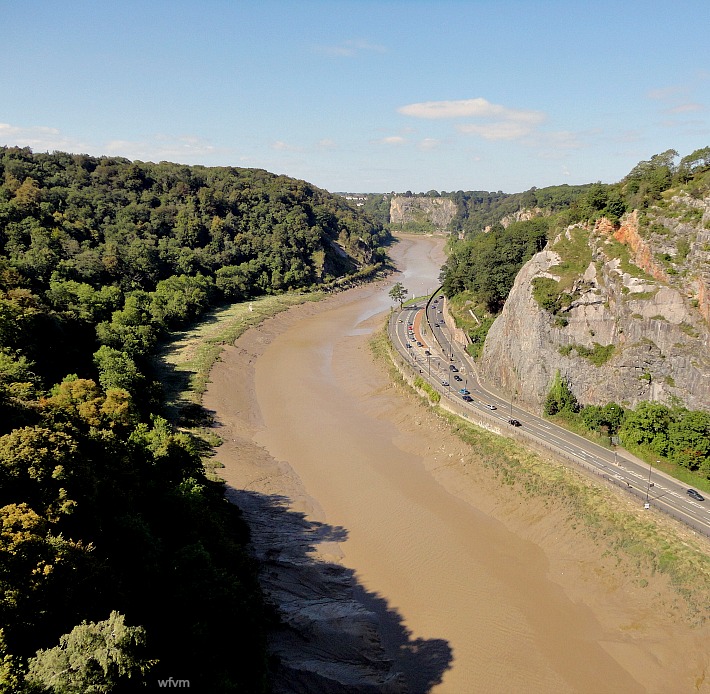
Whilst travelling along the road that runs beneath the Clifton Suspension Bridge that links the Avon Gorge, I have often thought how lovely it would be to visit it and see the view. Usually we are on our way to catch a plane or travelling down to the West Country for a holiday. Looking in my National Trust membership handbook I discovered that a walk through the forest seen on the left gives access to the bridge. So, on the last day of August, clutching our picnic basket, off we trekked through the woods,
and at the end of the trail this is what we found
The River Avon is a fast flowing river with a great tidal range - at low tide, as seen here, the water recedes almost completely to sandy mud. To navigate it is essential to have daily up to date charts and tide tables. 
When we crossed the bridge to the Bristol side people were relaxing and enjoying the late August sunshine.
via
It was from the Port of Bristol that Cabot sailed in 1497 in the 'Matthew' to land in Newfoundland. It is possible to visit a sea-going replica berthed in the floating harbour at Bristol, and you can also visit
via
Brunel's SS Great Britain which sits alongside the Brunel Institute. The institute houses one of the world's finest maritime collections.