Showing posts with label Design. Show all posts

Saturday, 28 April 2018

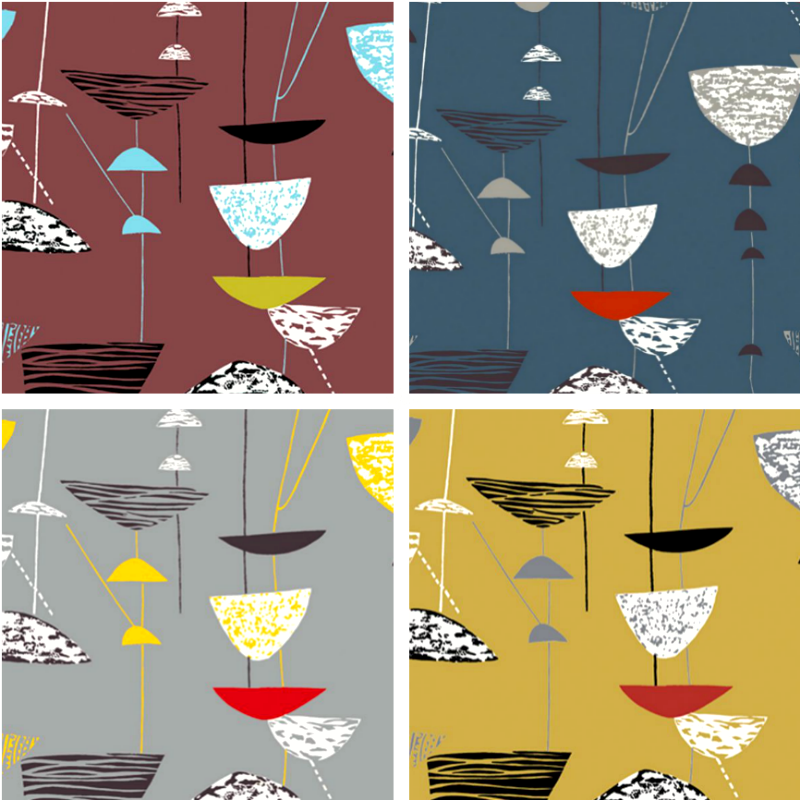
Lucienne Day - Textile Designer

Lucienne Day was born in 1917 and became one of the most influential British textile designers of the 1950s and 60s. She drew inspiration from other arts and developed a new style of abstract pattern known as 'Contemporary' design. In the year of the millenium, at the grand age of 83 she offically retired.
Lucienne Day photographed with her new pioneering 'contemporary' fabric design, "Calyx", which was shown for the first time at the Festival of Britain in 1951.

She met and married Robin Day, an already up and coming successful furniture designer. They both studied at the Royal College of Art where they met at a college dance. They immediately recognised in each other a kindred spirit and became inseparable. They were married for almost 70 years, and both died within months of one other in 2010 - Robin was 95, Lucienne 93. Together they forged an influential design partnership which lasted for over six decades.
Black leaf - tea towel
Lucienne designed patterns for furnishings, dress fabrics, table linen, carpets, wallpapers and ceramics. 
 Her designs are still being produced today demonstrating the continuing vitality of her design legacy.
Lucienne's designs brought joy and colour into domestic homes following the austerity of the war years.

I can think of several current designers, printmakers, and illustrators who appear to have been inspired by Lucienne. Amusingly what I think of as contemporary, the younger generation consider 'vintage'. They have rediscovered her designs and appear to love them.
Jack Sprat - tea towel
In later life she began making individual silk mosaics. She is pictured here with her silk mosaic 'Three Daughters of Mexico' which she made for the Senior Common Room at the Royal College of Art, and where she celebrated her 90th birthday with many old friends from the design world. 

Friday, 6 April 2018

The Pugin Floor Tile

There was a tangible golden ambience in Stanbrook Abbey chapel created by morning sunlight streaming through the windows, bouncing off the woodwork, and dancing across the floor tiles.
These exquisite floor tiles made by Mintons were designed by Edward Welby Pugin, the eldest son of eminent architect/designer, Augustus Welby Pugin.
The design of this tile captured our attention. It was used in the floor area separating the Eastern Chapel from the main body of the chapel known as The Choir

Originally the Eastern chapel had an elaborate metal screen which afforded privacy to The Choir area. A visiting priest could give his sermon from behind the screen unseen by the nuns sitting in The Choir. When the nuns stopped being an enclosed order during the early 1970s the screen had been removed.

   I found the design intriguing - what did it represent?
 

What was the bird - a Raven or a Crow

What did it carry in it's beak and was it of any significance?  
After exploring several blind alleys, I considered the fact that the nuns belonged to a Benedictine Order,
  and happily discovered that I was finally travelling along the right road.


 St. Benedict lived as a hermit, in spiritual isolation in a cave. Upon the death of an abbot in a nearby monastery, St. Benedict, who was known for his sanctity, was asked to become the new abbot. However, the strict discipline and obedience that he demanded so angered the other monks that they added poison to his bread. Each morning St. Benedict would feed pieces of his bread to a raven, but detecting the poison Benedict taught the bird to fly away with the deadly bread to a place where it could do no harm. St. Benedict decided to leave the monastery and returned to live in the wilderness that he loved. 

courtesy wiki
Saint Benedict of Nursia 480-543 Detail from a fresco by Fra Angelico (c. 1400-1455) in the Friary of San Marco, Florence
****
 
Nursia has now been renamed Norcia. It is a remote Italian town surrounded by the Apennines in Umbria. Norcia was at the epicentre of the Italian earthquake 18 months ago. Norcia is reknowned in Italy for its wild boar hams and sausages, along with its much sought after black truffles. We travelled there many years ago, but did not realise the significance of St. Benedict to the town at that time

Wednesday, 25 February 2015

British treasures No 4

Eyam is located in the Derbyshire High Peaks 800 feet above sea level, and is known as the Plague village. Here stands an ancient cross, considered to be one of the finest in the country, a Scheduled Ancient Monument, Grade 1 listed - a British treasure. I wonder how many people have passed this Saxon cross in St. Lawrence's churchyard without realising it's status. There is a small notice board stating that the cross is 8th century Celtic; it is carved with both Pagan and Christian imagery. The cross dates from the period in British history when Pagan beliefs still abounded and Christianity was a minority faith. This cross pre-dates the 13th century church in Eyam by 500 hundred years. There are several other Saxon crosses in Derbyshire but the one in Eyam churchyard is the most outstanding being almost intact. It is notable for the survival of the head, but sadly the top two feet of the shaft are missing. It was placed in the churchyard many years ago after it was removed from a nearby cart track. At one time it is thought to have been used as a wayside preaching cross years before the establishment of the church in Eyam. It has also been suggested that this cross may originally have lain on a piece of remote moorland just outside Eyam village, where there are several Neolithic remains including a Stone Circle, and a Long Barrow to be found. 
British Treasure No. 3 

Thursday, 5 June 2014

Wilton House

Wilton House lies a short distance from Salisbury Cathedral, it has been the country seat of the Earls of Pembroke for over 450 years, 
During the 18th century, James Wyatt, created a new main entrance to Wilton house from the North forecourt through a Triumphal Arch surmounted by an equestrian statue of Marcus Aurelius.
A house filled with treasures - statuary from ancient Greece and Rome, world famous paintings, exquisite furniture by Thomas Chippendale and William Kent, painted ceilings by Cavalier D'Arpino, and Thomas de Critz, walls with gilded and painted wooden swags running from floor to ceiling interspersed with  mirrors by Chippendale.
A very small section of a swag scanned from my entrance ticket, and three of the many memorable paintings
via  
Sir Anthony van Dyck - Philip Herbert, 4th Earl of Pembroke with his family
Sir Anthony van Dyck - The three eldest children of Charles l
Rembrandt's Mother
 courtyard garden
The first building on the site was a priory founded by King Egbert in 871. It is still possible to see traces of the old abbey inside the house below the ground floor. Wilton Abbey was very prosperous but by the time of the Dissolution of the Monasteries it was on the wane. King Henry Vlll presented it and the estates to William Herbert, 1st Earl of Pembroke in 1551. The scion of a distinguished Welsh family he was a favourite of the King.
Only one part of the original great mansion survives today, the central Tudor tower, which bears a strong resemblance to the entrance of Hampton Court.
The two wings that replaced the original Tudor building were added during the 17th century and are attributed to Inigo Jones revealing just how much the building has evolved over the years in to what is the accepted customary style of an English country house.
The Palladian Bridge crossing the River Nadder was designed in 1736 by the 9th Earl of Pembroke. He based his bridge on an unexecuted design of Andrea Palladio for the Rialto Bridge in Venice which he then combined with design aspects of a classical Roman temple.
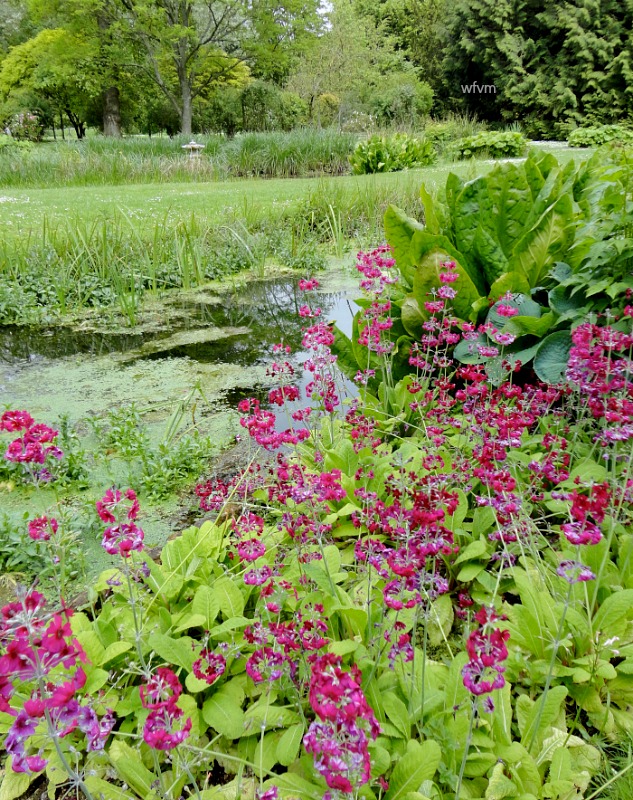
A leafy entrance tunnel leads down to a relatively new creation, the water garden, an Oriental garden area with ponds linked by Chinese style bridges
Primula puverulenta -candelabra primulas - and 
Lysichiton americanus - skunk cabbage

Thursday, 20 February 2014

Willow Pattern

Two birds flying high,
A Chinese vessel, sailing by.
A bridge with three men, sometimes four,
A willow tree, hanging o'er.
A Chinese temple, there it stands,
Built upon the river sands,
An apple tree, with apples on,
A crooked fence to end my song.
The childhood home that I grew up in had an oak plate rack running around the dining room walls.  It held my mother's eclectic collection of blue and white china some of which was willow pattern. As a child I recall looking at the plates and wondering about the story behind the design - two love birds at the top, a little boat on a lake, three people crossing a Chinese style bridge, a Pagoda, a zigzag fence, and of course the depiction of the willow tree itself.
Willow Pattern is often assumed to be a story from China, but it was a tale conceived in England by Mintons, one of the major ceramics manufacturers, to promote and encourage people to buy their willow pattern wares.
The Romantic Fable
Once there was a wealthy Mandarin, who had a beautiful daughter (Koong-se). She had fallen in love with her father's humble accounting assistant (Chang), angering her father. It was inappropriate for them to marry due to their difference in social class. He dismissed the young man and built a high fence around his house to keep the lovers apart. The Mandarin was planning for his daughter to marry a powerful Duke. The Duke arrived by boat to claim his bride, bearing a box of jewels as a gift. The wedding was to take place on the day the blossom fell from the apple tree.
On the eve of the daughter's wedding to the Duke, the young accountant, disguised as a servant, slipped into the palace unnoticed. As the lovers escaped with the jewels, the alarm was raised. They ran over a bridge, chased by the Mandarin, whip in hand. They eventually escaped on the Duke's ship to the safety of a secluded island, where they lived happily for years. But one day, the Duke learned of their refuge. Hungry for revenge, he sent soldiers, to capture the lovers and put them to death. The gods, moved by their plight, transformed the lovers into a pair of doves.


Sunday, 9 February 2014

Heathers

We live on Cotswold oolitic limestone which gives alkaline soil, not conducive to growing Heathers. Heathers belong to the Ericaceae family and require an acidic soil to flourish. 
The site where we were interested in growing heathers was infertile and at the edge of a stone patio with bits of stone and concrete residue left behind from when it was made. How then to put acid loving plants into alkaline and rubbish soil? Following some investigations, I discovered three happy pieces of information.  Heathers can tolerate infertile soil due to a fungi that they have called mycorrhizal which assists them in extracting whatever nutrients they can find from infertile soil. My second discovery was that there are some heathers that do thrive very happily in alkaline soil. As long as the heather has the words Erica carnea or Erica x darleyensis on the label then they will flourish in alkaline soil. I managed to track down over 30 cultivars covering the whole spectrum of heather colours from deepest ruby pink with dark green foliage to white and pink with pale cream and lime green foliage. The third and final discovery was that they like good drainage, which we most definitely have.
We planted small immature Common Box hedging plants (Buxus sempervirens) along the patio edge interspersed with different heathers on either side. As the box matured we began to clip it into the shape of balls. The heather was also clipped so that it snuggled around the bottom of the box balls. Ten years later they are mature - thriving incredibly well - the only maintenance being a quick annual trim.